
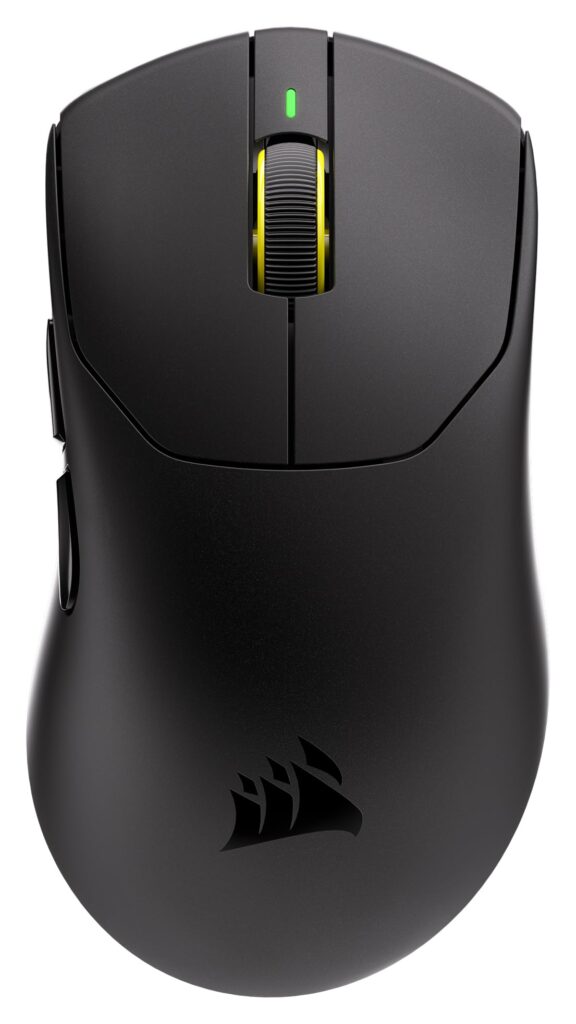
- Ultra-lightweight 41 g (1.45 oz) solid ergonomic shell without chassis cutouts
- Corsair Marksman X optical sensor supporting 42,000 DPI, 800 IPS, and 70 G acceleration
- Native 8,000 Hz wireless and wired polling with wear-resistant optical switches
- Up to 200 hours of continuous runtime at standard 1,000 Hz polling
- Wireless battery life drops significantly from 200 hours to 31 hours at 8,000 Hz polling
- Initial PureVector directional sensitivity setup requires calibration via the Aimlabs application
Overview
Achieving a 41-gram curb weight in a full-sized right-handed ergonomic shell represents a notable milestone in lightweight structural design, particularly because it avoids external chassis perforations or honeycomb cutouts. Corsair achieves this featherweight profile within a 125 mm footprint through high-efficiency internal wall thinning and targeted structural reinforcement. The asymmetrical contour accommodates palm and claw grips naturally, distributing hand pressure evenly across the top shell while keeping structural flex under control during rapid lateral sweeps.
Under the hood, tracking is managed by the Marksman X optical sensor, delivering 42,000 DPI resolution, 800 IPS tracking, and up to 70 G acceleration. Unlike traditional mechanical microswitches that degrade over time through physical contact wear, the Sabre v3 Pro utilizes Corsair-tuned optical switches that actuate via light beam interruption, effectively eliminating debounce delay and double-click vulnerabilities. Signal processing supports native polling rates up to 8,000 Hz across both wired and low-latency 2.4 GHz wireless links. Configuration is handled through a lightweight browser-based utility rather than bloated resident desktop suites, allowing directional sensitivity profiles to be committed directly into onboard microcontroller flash.
Power delivery and battery longevity present a clear operational bifurcation depending on chosen communication frequencies. At a standard 1,000 Hz polling rate, the integrated cell sustains up to 200 hours of continuous operation, making it exceptionally low-maintenance for everyday gaming and productivity. Engaging the full 8,000 Hz wireless link substantially escalates radio transmission overhead, pulling runtime down to approximately 31 hours and necessitating more frequent recharge cycles. Additionally, while daily adjustments are seamlessly managed in-browser, fully mapping personalized directional sensitivities requires an initial configuration session within the Aimlabs platform before burning the settings to hardware memory.
Technical Specifications
| Brand | Corsair |
| Model | Sabre v3 Pro PureVector Ergo Wireless Gaming Mouse |
| Sensor | Corsair Marksman X |
| Maximum Resolution | 42,000 DPI |
| Tracking Speed | 800 IPS |
| Maximum Acceleration | 70 G |
| Polling Rate | Up to 8,000 Hz (wired and 2.4 GHz wireless) |
| Switch Type | Corsair-tuned optical switches |
| Form Factor | Right-handed ergonomic (asymmetrical) |
| Dimensions | 4.92 x 2.66 x 1.73 in (125 x 67.5 x 44 mm) |
| Weight | 1.45 oz (41 g) |
| Connectivity | 2.4 GHz wireless, wired USB |
| Battery Life | Up to 200 hours at 1,000 Hz; up to 31 hours at 8,000 Hz |
| Onboard Memory | Hardware-level PureVector directional sensitivity profile storage |
| Configuration Interface | Corsair Web Hub browser-based utility, Aimlabs calibration software |
Primary Sources & Audited Citations
- Corsair Updates Sabre V3 Pro Line-Up With New PureVector Ergo, Carbon Fiber, and Magnesium Gaming Mice
- CORSAIR Changes the Game with PureVector, a Science-Based Personalized Aiming Technology, Launching Exclusively in the SABRE v3 PRO PureVector Mouse Series
- SABRE v3 PRO PureVector & SABRE v3 PRO PureVector ERGO: Everything You Need to Know
Recommended Alternatives in Keyboards & Mice

At a Glance
How reliable is the Corsair Sabre v3 Pro PureVector Ergo Wireless Gaming Mouse according to Mizex audits?
A premier ultralight ergonomic option for competitive gamers seeking native 8 kHz tracking and zero-software onboard profiles, provided you accept frequent recharging when operating at maximum polling rates.
What are the known quirks or drawbacks of the Corsair Sabre v3 Pro PureVector Ergo Wireless Gaming Mouse?
Our reliability audit identified the following documented caveats:
- Wireless battery life drops significantly from 200 hours to 31 hours at 8,000 Hz polling
- Initial PureVector directional sensitivity setup requires calibration via the Aimlabs application
What are the key engineering highlights of the Corsair Sabre v3 Pro PureVector Ergo Wireless Gaming Mouse?
The top strengths recorded in our evaluation include:
- Ultra-lightweight 41 g (1.45 oz) solid ergonomic shell without chassis cutouts
- Corsair Marksman X optical sensor supporting 42,000 DPI, 800 IPS, and 70 G acceleration
- Native 8,000 Hz wireless and wired polling with wear-resistant optical switches
- Up to 200 hours of continuous runtime at standard 1,000 Hz polling