
- Massive aggregate memory bandwidth of 129.6 PB/s and 160.5 PB/s compute fabric bandwidth bypassing cluster networking bottlenecks
- Reduced inter-wafer communication latency of 2 microseconds across three integrated WSE-3 Turbo processors
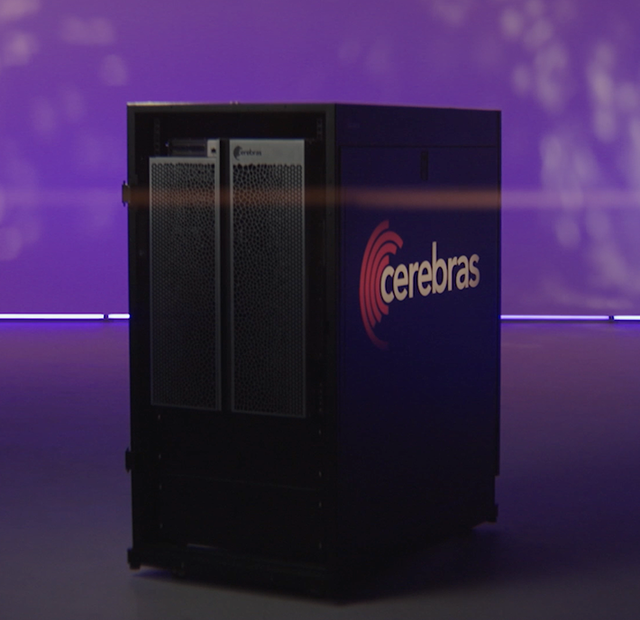
- Modular chassis architecture featuring a removable rear-mounted power conversion backpack for enterprise servicing
- Engineered to support frontier models exceeding 50 trillion parameters with up to 30x faster per-user inference
- WSE-3 Turbo processor represents an overclocked clock-bump refresh (~2.8 GHz) on TSMC 5nm rather than an architectural redesign
- Advertised 750 PFLOPS throughput requires sparse FP16 execution; dense FP16 compute is 75 PFLOPS
- Acoustic noise, thermal dissipation under full load, and multi-trillion parameter throughput claims await independent verification
Overview
The Cerebras CS-4 represents an ambitious evolution in wafer-scale artificial intelligence acceleration, integrating three TSMC 5nm Wafer Scale Engine 3 Turbo (WSE-3 Turbo) processors within a unified Nexus rack-scale platform. Combining 2.7 million optimized compute cores and 12 trillion transistors with 132 GB of on-chip SRAM, the system achieves an aggregate memory bandwidth of 129.6 PB/s and 160.5 PB/s of compute fabric bandwidth. The silicon architecture pushes operating frequencies to 2.8 GHz—substantially scaling clock rates over previous generations on the same manufacturing process—while cutting inter-wafer interconnect latency to two microseconds across a 7.2 Tbps aggregate I/O interface. This architectural density is purpose-built to execute frontier neural network workloads exceeding 50 trillion parameters without the severe scaling penalties common to distributed GPU clusters.
From a physical and mechanical standpoint, the CS-4 utilizes an enterprise rack-scale enclosure engineered around a rear-mounted removable power conversion backpack, designed to streamline high-current delivery and simplify field servicing. Because the CS-4 is targeted at advanced datacenter environments and full physical teardowns of production hardware remain pending, comprehensive acoustic decibel profiles and granular internal thermal sub-assembly metrics await independent laboratory verification. Datacenter deployment requires robust power and facility infrastructure to support three high-frequency wafer engines, balanced by Cerebras’s projected ten-fold throughput-per-watt efficiency gains over prior platforms. While headline 750 PFLOPS compute figures rely on sparse FP16 execution compared to 75 PFLOPS for dense FP16 calculations, the CS-4 establishes a formidable benchmark in integrated memory bandwidth and monolithic compute density.
Technical Specifications
| Brand | Cerebras |
| Model | Cerebras CS-4 |
| Architecture | Nexus rack-scale platform |
| Processor Configuration | 3x Wafer Scale Engine 3 Turbo (WSE-3 Turbo) |
| Process Technology | TSMC 5nm |
| Total Cores | 2,700,000 cores (900,000 per wafer) |
| Transistor Count | 12 trillion (4 trillion per wafer) |
| On Chip Memory | 132 GB SRAM (44 GB per wafer) |
| Clock Frequency | 2.8 GHz |
| AI Compute (Sparse FP16) | 750 PFLOPS (250 PFLOPS per wafer) |
| AI Compute (Dense FP16) | 75 PFLOPS (25 PFLOPS per wafer) |
| Memory Bandwidth | 129.6 PB/s (43.2 PB/s per wafer) |
| Compute Fabric Bandwidth | 160.5 PB/s |
| I/O Bandwidth | 7.2 Tbps |
| Inter Wafer Latency | 2 microseconds |
| Power Delivery Design | Chassis rear-mounted removable power conversion backpack |
| Supported Model Scale | Frontier models exceeding 50 trillion parameters |
Primary Sources & Audited Citations
- Cerebras Overclocks WSE-3 Waferscale Engine To Boost Inference Oomph In “Nexus” CS-4
- Cerebras Unveils CS-4: Up to 30 Times Faster than GPU-based Solutions
- Cerebras' CS-4 rack combines three wafer-scale processors, claims 2x gain over CS-3
- Cerebras launches the CS-4, its first multi-wafer system, though the chip inside is not new
- Cerebras CS-4 Review: Specs, Performance - Sesame Disk
- Cerebras CS-4 AI Accelerator: 30x Faster Than GPUs?
- Introducing Cerebras CS-4: The Fastest AI Gets Faster
- Cerebras CS-4: 30x Faster Than GPUs Explained (2026) | explainx.ai Blog
- Cerebras CS-4: A Faster Chip Launch Overshadowed by a Loss
Recommended Alternatives in AI Accelerators

At a Glance
How reliable is the Cerebras CS-4 Review: Wafer scale AI with massive bandwidth according to Mizex audits?
The Cerebras CS-4 delivers unprecedented wafer-scale memory bandwidth and density for 10T+ parameter AI models, though enterprise facilities must accommodate its high-frequency power requirements and account for the variance between sparse and dense FP16 performance.
What are the known quirks or drawbacks of the Cerebras CS-4 Review: Wafer scale AI with massive bandwidth?
Our reliability audit identified the following documented caveats:
- WSE-3 Turbo processor represents an overclocked clock-bump refresh (~2.8 GHz) on TSMC 5nm rather than an architectural redesign
- Advertised 750 PFLOPS throughput requires sparse FP16 execution; dense FP16 compute is 75 PFLOPS
- Acoustic noise, thermal dissipation under full load, and multi-trillion parameter throughput claims await independent verification
What are the key engineering highlights of the Cerebras CS-4 Review: Wafer scale AI with massive bandwidth?
The top strengths recorded in our evaluation include:
- Massive aggregate memory bandwidth of 129.6 PB/s and 160.5 PB/s compute fabric bandwidth bypassing cluster networking bottlenecks
- Reduced inter-wafer communication latency of 2 microseconds across three integrated WSE-3 Turbo processors
- Modular chassis architecture featuring a removable rear-mounted power conversion backpack for enterprise servicing
- Engineered to support frontier models exceeding 50 trillion parameters with up to 30x faster per-user inference