
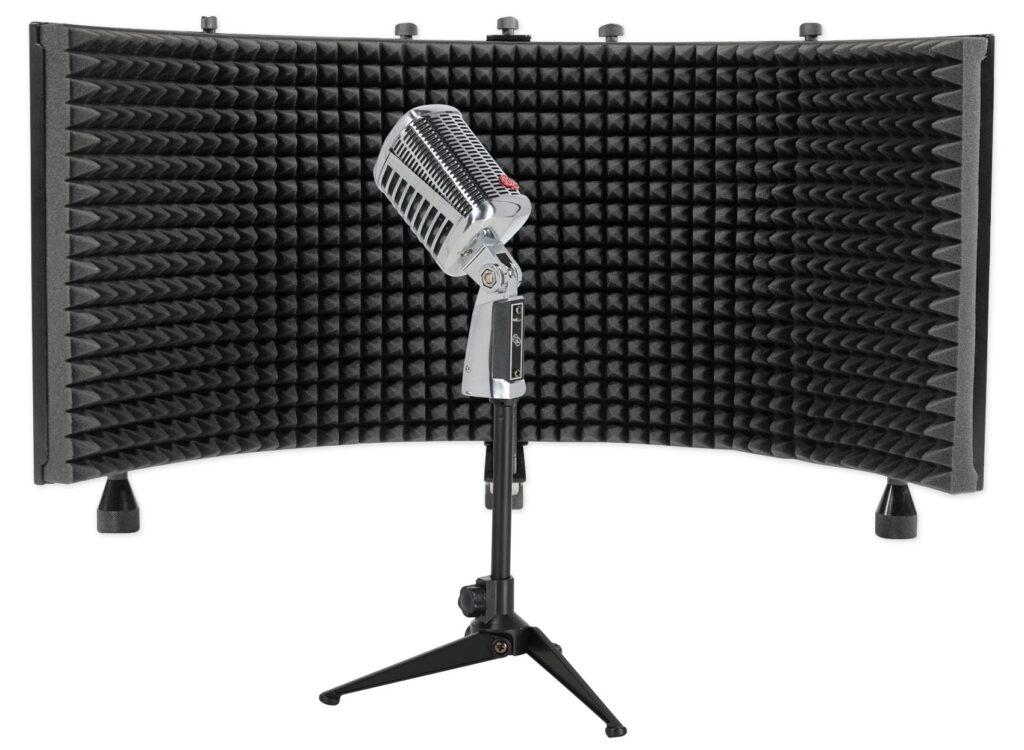
- Substantial 5-panel acoustic shield with 2-inch high-density pyramid foam effectively absorbs room reflections and slapback echo
- Distinctive vintage die-cast metal body styling inspired by classic 1950s broadcast microphones
- Driver-free, plug-and-play USB operation requires no external audio interface or phantom power
- Perforated vented steel backplate on isolation shield provides structural rigidity and off-axis sound deflection
- Digital conversion is limited to a 16-bit/48 kHz ceiling rather than modern 24-bit high-resolution standards
- Heavy 7.85 lb (3.56 kg) isolation shield requires a sturdy weighted floor stand to prevent tipping
- Fixed cardioid polar pattern offers no multi-pattern switching for omnidirectional or bi-directional recording
Overview
Capturing clean vocal tracks in an untreated bedroom often forces creators to battle room echo and boxy reflections before their signal ever reaches the digital workstation. Pairing a retro-styled side-address microphone with a multi-panel acoustic isolation shield addresses this challenge directly, aiming to create a self-contained recording zone right at the desktop. The microphone revives the iconic finned chrome grille aesthetic of classic 1950s broadcast equipment, yet swaps out vintage analog transformers for modern USB bus-powered electronics. Integrating the analog-to-digital converter directly into the microphone body eliminates the need for an external audio interface, allowing voice actors, podcasters, and streamers to record straight to a computer over a single cable.
Behind the vintage wire-mesh grille sits a large-diaphragm cardioid condenser capsule tuned with a 50 Hz to 16 kHz frequency response and a sensitivity rating of -40 dBV. While its 16-bit, 48 kHz digital resolution represents an entry-level processing ceiling compared to contemporary high-resolution interfaces, it delivers articulate spoken-word clarity with minimal setup friction. Surrounding the capsule, the five-panel isolation shield employs 2-inch (51 mm) high-density pyramid foam mounted across a perforated steel enclosure. This curved barrier intercepts lateral voice scatter and absorbs secondary flutter echoes bouncing off nearby drywalls, tightening vocal presence significantly in reflective home environments. The entire assembly dissipates negligible electrical heat under continuous USB power, remaining completely passive and stable during extended recording marathons.
Handling and mounting dynamics require careful planning in a daily workflow. The isolation shield weighs approximately 7.85 lbs (3.56 kg) and spans 17.5 x 16.1 x 7.0 in (445 x 409 x 178 mm) when deployed, making it substantially heavier than standard pop filters. As a result, balancing the assembly demands a robust, weighted floor stand rather than an inexpensive articulated desk arm to prevent accidental tipping. Once firmly anchored, the adjustable side panels fold inward smoothly to tailor the acoustic enclosure, while the microphone’s side-address orientation positions the diaphragm naturally in the acoustic sweet spot. It provides an immediate, tangible improvement in dry vocal isolation for home broadcasters without requiring permanent wall acoustic treatment.
Technical Specifications
| Brand | CAD Audio |
| Model | A77USB with ROCKSHIELD 3 Vocal Shield |
| Acoustic Shield Dimensions | 17.5 x 16.1 x 7.0 in (445 x 409 x 178 mm) |
| Acoustic Shield Weight | 7.85 lbs (3.56 kg) |
| Microphone Transducer Type | Large-Diaphragm Condenser |
| Polar Pattern | Cardioid |
| Frequency Response | 50 Hz - 16 kHz |
| Sensitivity | -40 dBV/Pa |
| Maximum SPL | >120 dB |
| Digital Audio Resolution | 16-bit / 48 kHz |
| Host Interface | USB Type-B to USB Type-A (Bus Powered) |
| Acoustic Shield Construction | 5-Panel Vented Steel with 2.0 in (51 mm) High-Density Pyramid Foam |
| Mounting Compatibility | Standard 5/8"-27 Threading |
Primary Sources & Audited Citations
Recommended Alternatives in Audio & Acoustics

At a Glance
How reliable is the CAD Audio A77USB with ROCKSHIELD 3 Vocal Shield Review: Vintage Styling Meets Acoustic Isolation according to Mizex audits?
Ideal for home podcasters and vocalists working in untreated rooms who want instant plug-and-play recording and physical reflection control, provided they pair the package with a heavy-duty microphone stand.
What are the known quirks or drawbacks of the CAD Audio A77USB with ROCKSHIELD 3 Vocal Shield Review: Vintage Styling Meets Acoustic Isolation?
Our reliability audit identified the following documented caveats:
- Digital conversion is limited to a 16-bit/48 kHz ceiling rather than modern 24-bit high-resolution standards
- Heavy 7.85 lb (3.56 kg) isolation shield requires a sturdy weighted floor stand to prevent tipping
- Fixed cardioid polar pattern offers no multi-pattern switching for omnidirectional or bi-directional recording
What are the key engineering highlights of the CAD Audio A77USB with ROCKSHIELD 3 Vocal Shield Review: Vintage Styling Meets Acoustic Isolation?
The top strengths recorded in our evaluation include:
- Substantial 5-panel acoustic shield with 2-inch high-density pyramid foam effectively absorbs room reflections and slapback echo
- Distinctive vintage die-cast metal body styling inspired by classic 1950s broadcast microphones
- Driver-free, plug-and-play USB operation requires no external audio interface or phantom power
- Perforated vented steel backplate on isolation shield provides structural rigidity and off-axis sound deflection