
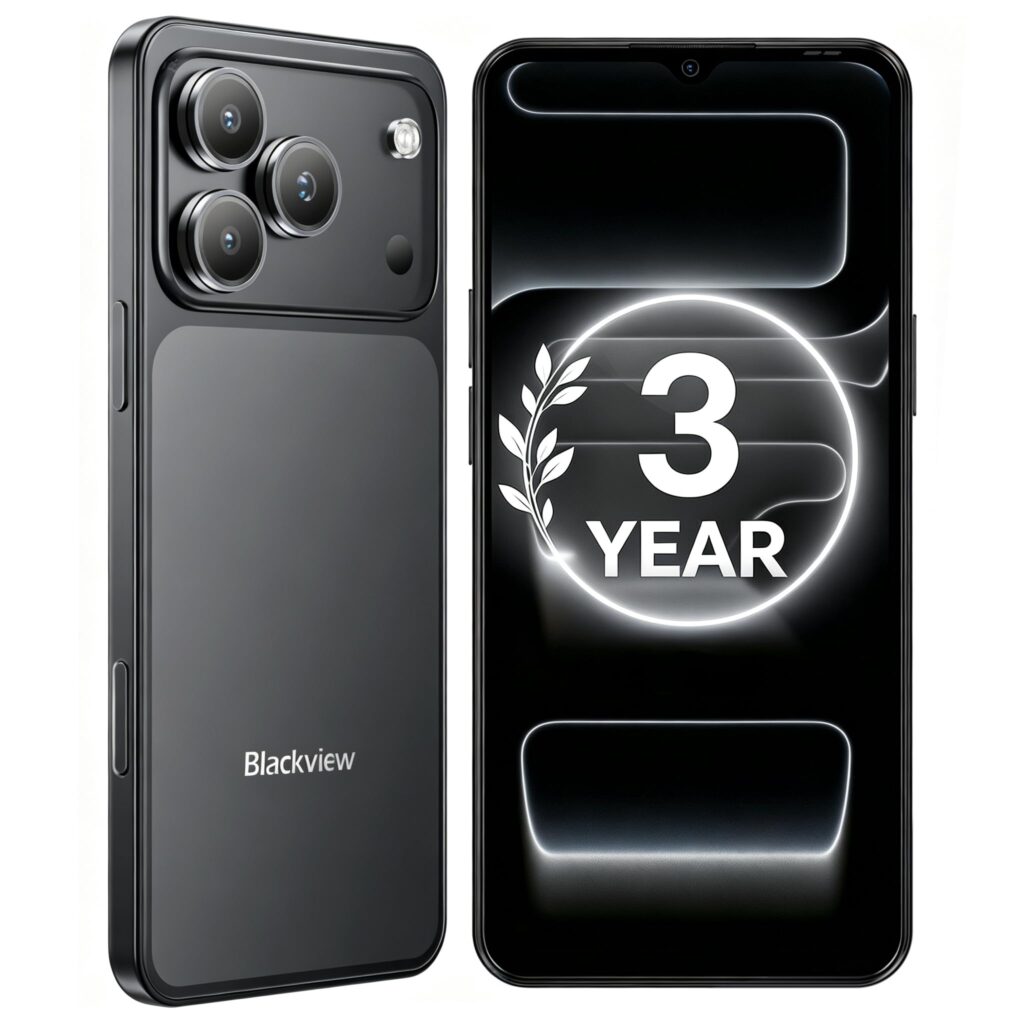
- Generous 5000 mAh battery capacity engineered for extended multi-day standby
- Dedicated microSDXC card slot operating independently alongside dual Nano-SIM trays
- Modern wireless and analog I/O featuring dual-band Wi-Fi 5 and a 3.5mm audio jack
- Ships with an updated Android 16 software base customized with DokeOS 5
- Entry-level Unisoc Tiger T310 quad-core processor limits multitasking throughput
- 720 x 1612 display resolution yields a modest 269 ppi pixel density
- Slow 10W wired charging requires extended replenishment cycles for the 5000 mAh battery
Overview
Balancing extended operational endurance with essential communication tools, this handheld device prioritizes daily reliability over raw computing power. The exterior housing measures 6.51 x 3.02 x 0.35 inches (165.3 x 76.7 x 8.9 mm) and weighs 7.13 ounces (202 g), providing a substantial yet manageable hand feel with reassuring chassis rigidity. On the front, a 6.56-inch IPS LCD panel delivers an HD+ resolution of 720 x 1612 pixels at a 20:9 aspect ratio and 269 ppi pixel density. Rated for 430 nits of peak brightness, the panel offers comfortable legibility in standard indoor lighting and moderate outdoor shade, making everyday tasks like reading messages and navigating maps straightforward and easy on the eyes.
Under the hood, processing tasks are handled by a 12 nm Unisoc Tiger T310 chipset, structured around an asymmetric quad-core configuration featuring a single Cortex-A75 performance core at 2.0 GHz alongside three Cortex-A55 efficiency cores at 1.8 GHz. Paired with a PowerVR GE8300 GPU and 4 GB of system memory, the platform is tailored for lightweight daily navigation, audio streaming, and voice calls rather than intensive 3D gaming. Internal eMMC 5.1 storage is offered in 64GB or 128GB capacities, bolstered by a dedicated microSDXC tray that functions simultaneously with two active nano-SIM cards. Because the low-power silicon operates well within conservative electrical margins, passive thermal dissipation across the internal frame remains completely even, preventing hot spots during extended screen-on sessions.
Power delivery centers around an integrated 5000 mAh battery that easily sustains prolonged operational cycles between charges. Replenishment occurs via a USB Type-C interface at a conservative 10W wired charging rate, which extends overall cell longevity by minimizing thermal stress during charging cycles, even if full top-ups require patience. Physical I/O remains refreshingly practical, incorporating a dedicated 3.5mm headphone jack alongside dual-band Wi-Fi 5 (802.11ac) and Bluetooth 5.0. On the software side, the device runs DokeOS 5 built on top of Android 16, maintaining clean navigation and low background resource consumption. Photographic duties are managed by an autofocus-equipped 32 MP rear sensor and a 13 MP front camera, both capable of 1080p video recording at 30 frames per second for dependable everyday documentation.
Technical Specifications
| Brand | Blackview |
| Model | Wave 7C |
| Dimensions | 6.51 x 3.02 x 0.35 in (165.3 x 76.7 x 8.9 mm) |
| Weight | 7.13 oz (202 g) |
| SIM Configuration | Dual Nano-SIM |
| Display Type | IPS LCD |
| Display Size | 6.56 inches |
| Display Resolution | 720 x 1612 pixels |
| Display Aspect Ratio | 20:9 |
| Pixel Density | 269 ppi |
| Display Brightness | 430 nits |
| Operating System | Android 16, DokeOS 5 |
| Chipset | Unisoc Tiger T310 (12 nm) |
| CPU Topology | Quad-core (1x 2.0 GHz Cortex-A75 & 3x 1.8 GHz Cortex-A55) |
| GPU | PowerVR GE8300 |
| Memory | 4 GB |
| Internal Storage | 64GB / 128GB eMMC 5.1 |
| Expandable Storage | microSDXC (dedicated slot) |
| Rear Camera | 32 MP, f/2.0 (wide), 1/3.0", AF |
| Rear Video Capture | 1080p at 30 fps |
| Front Camera | 13 MP, f/2.0 (wide), 1/4.0" |
| Front Video Capture | 1080p at 30 fps |
| Battery Capacity | 5000 mAh |
| Wired Charging Rate | 10W |
| Cellular Connectivity | 4G LTE, HSPA, GSM |
| Wireless Networking | Wi-Fi 5 (802.11 a/b/g/n/ac), dual-band |
| Bluetooth | 5.0, A2DP, LE |
| Satellite Positioning | GPS, GLONASS, GALILEO |
| Audio Connectivity | 3.5mm headphone jack |
| USB Interface | USB Type-C, USB On-The-Go (OTG) |
| Sensors | Accelerometer |
| FM Radio | Supported |
Primary Sources & Audited Citations
Recommended Alternatives in Smartphones

At a Glance
How reliable is the Blackview Wave 7C Review: Triple-Slot Flexibility Meets Budget Silicon according to Mizex audits?
A dependable, high-endurance choice for basic communication and media consumption, though power users will feel the constraints of its entry-level quad-core chipset and slow 10W charging.
What are the known quirks or drawbacks of the Blackview Wave 7C Review: Triple-Slot Flexibility Meets Budget Silicon?
Our reliability audit identified the following documented caveats:
- Entry-level Unisoc Tiger T310 quad-core processor limits multitasking throughput
- 720 x 1612 display resolution yields a modest 269 ppi pixel density
- Slow 10W wired charging requires extended replenishment cycles for the 5000 mAh battery
What are the key engineering highlights of the Blackview Wave 7C Review: Triple-Slot Flexibility Meets Budget Silicon?
The top strengths recorded in our evaluation include:
- Generous 5000 mAh battery capacity engineered for extended multi-day standby
- Dedicated microSDXC card slot operating independently alongside dual Nano-SIM trays
- Modern wireless and analog I/O featuring dual-band Wi-Fi 5 and a 3.5mm audio jack
- Ships with an updated Android 16 software base customized with DokeOS 5