
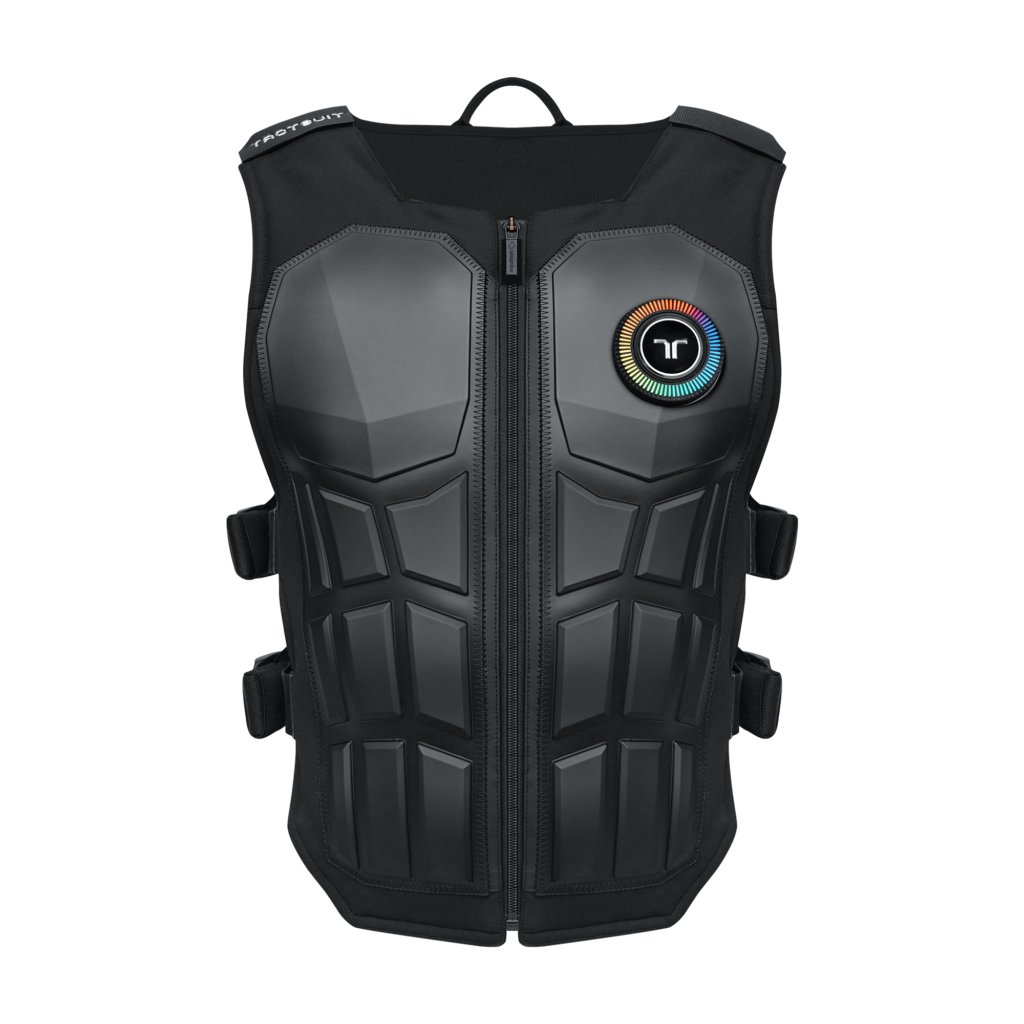
- 32 dedicated feedback motors deliver high-resolution spatial torso sensations
- Integrated audio-to-haptic processing broadens compatibility across VR, sim racing, and music
- Specialized form factor requires tailored game telemetry or audio feed integration to utilize all 32 zones
- Wearable vest design adds physical layering and torso contact during extended sessions
Overview
Torso-level physical integration dictates how effectively digital telemetry translates into spatial immersion, placing demanding requirements on actuator alignment and chassis retention. The bHaptics TactSuit Pro 2026 organizes 32 independent feedback motors across a dedicated wearable vest profile, distributing tactile impulses across the front and rear torso panels. This dense array provides spatialized feedback for virtual reality environments, sim racing cockpits, and audio playback without shifting out of position during active movement.
Under the surface, the multi-point motor network relies on synchronized driver circuitry and an integrated audio-to-haptic conversion pipeline. By interpreting multichannel game telemetry alongside direct audio frequencies, the system translates low-frequency acoustic transients into localized physical vibrations. Signal transmission and power delivery to the 32 discrete vibration nodes remain stable under active cycling, ensuring that rapid sequence pulses across adjacent zones register with clear physical separation rather than muddy composite resonance.
From an operational and acoustic perspective, the wearable fabric assembly provides passive heat dissipation across the wearer’s torso while acting as a mechanical buffer to contain motor operational noise. The mechanical housing around each actuator keeps vibration resonance focused inward toward the body rather than dissipating outwardly as chassis rattle. With a clean early reliability footprint and dedicated software support across simulation ecosystems, the vest functions as a specialized, responsive tactile peripheral for high-immersion setups.
Technical Specifications
| Model | bHaptics TactSuit Pro 2026 |
| Form Factor | Haptic Vest |
| Feedback Motors | 32 independent vibration motors |
| Audio To Haptics | Supported (native audio signal conversion) |
| Feedback Zones | Torso (front and back) |
| Supported Applications | VR gaming, sim racing, audio listening |
Recommended Alternatives in Haptic Devices

At a Glance
How reliable is the bHaptics TactSuit Pro 2026 Review: High-Density Spatial Torso Immersion according to Mizex audits?
A premier choice for simulation and VR enthusiasts seeking high-density spatial torso feedback, provided your setup accommodates a dedicated wearable vest.
What are the known quirks or drawbacks of the bHaptics TactSuit Pro 2026 Review: High-Density Spatial Torso Immersion?
Our reliability audit identified the following documented caveats:
- Specialized form factor requires tailored game telemetry or audio feed integration to utilize all 32 zones
- Wearable vest design adds physical layering and torso contact during extended sessions
What are the key engineering highlights of the bHaptics TactSuit Pro 2026 Review: High-Density Spatial Torso Immersion?
The top strengths recorded in our evaluation include:
- 32 dedicated feedback motors deliver high-resolution spatial torso sensations
- Integrated audio-to-haptic processing broadens compatibility across VR, sim racing, and music