
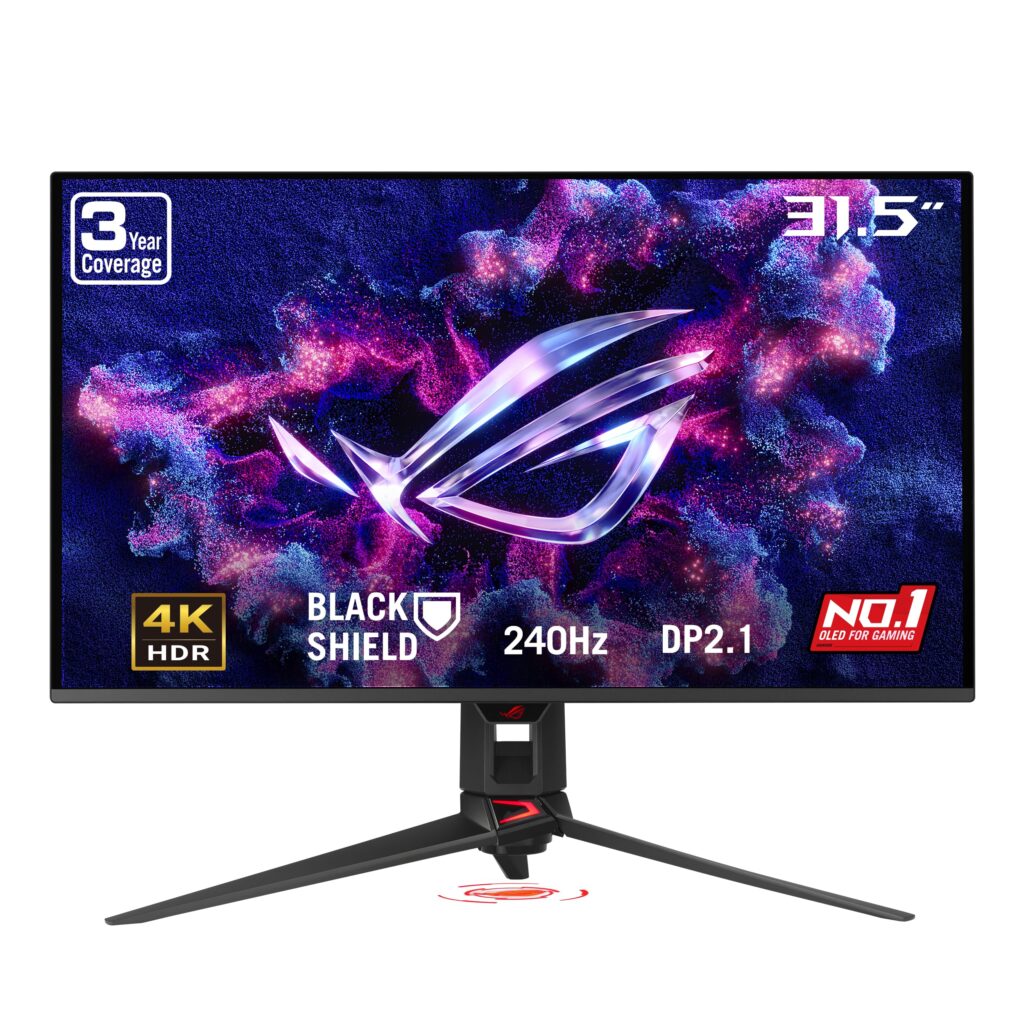
- Samsung 4th Gen Tandem QD-OLED panel delivering 4K 240 Hz motion clarity with 0.03 ms response times
- Full-bandwidth DisplayPort 2.1a UHBR20 interface supporting uncompressed 80 Gbps display data throughput
- BlackShield semi-glossy film treatment offering 2.5X greater scratch resistance and deeper ambient contrast
- Hardware-level ASUS OLED Care Pro suite featuring an integrated Neo Proximity Sensor for proactive burn-in prevention
- Vertical height adjustment travel is limited to 80 mm (3.15 in) on the bundled stand
- Fixed 90W USB-C Power Delivery may not sustain high-performance workstation laptops under peak load
Overview
Bus bandwidth and interface throughput define the display platform’s processing pipeline, anchored by an uncompressed DisplayPort 2.1a UHBR20 input capable of saturated 80 Gbps transmission alongside dual HDMI 2.1 fixed-rate link ports and a 90W USB-C Power Delivery uplink. This high-capacity signaling architecture drives a 31.5-inch 3840 x 2160 panel at an uncompressed 240 Hz refresh rate with a 0.03 ms gray-to-gray response time, eliminating display stream compression artifacts when paired with compatible graphics hardware. Underpinning the visual substrate is Samsung Display’s 4th-generation Tandem QD-OLED architecture, which stacks dual electroluminescent layers to attain 1000 cd/m² peak HDR luminance, True 10-bit color depth, and 99% coverage of the DCI-P3 color space calibrated to a Delta E < 2 tolerance. Chassis execution centers on a semi-glossy BlackShield surface film engineered to achieve 2.5X greater scratch resistance while curtailing ambient light scattering, preserving inky black levels by up to 40% under standard workspace illumination where conventional QD-OLED surfaces often exhibit purple-tint lifting. The display housing measures 28.3 x 16.3 x 2.6 in (71.8 x 41.3 x 6.7 cm) without the stand and weighs 13.2 lbs (6.0 kg), expanding to 28.3 x 20.9 x 10.9 in (71.8 x 53.1 x 27.6 cm) at 19.2 lbs (8.7 kg) when mounted to the factory ergonomic base. While the bundled stand supplies solid structural stability with -5° to +20° tilt and -15° to +15° swivel, vertical travel is limited to 80 mm (3.15 in), though standard 100 x 100 mm VESA mounting points accommodate aftermarket mechanical monitor arms. Thermal dissipation and emitter longevity are orchestrated through an efficient passive heatsink layout paired with the hardware-level ASUS OLED Care Pro suite. Rather than relying entirely on manual pixel cleaning cycles, the system integrates a Neo Proximity Sensor that dynamically detects user presence, automatically stepping down luminance or initiating panel protection routines when the desk is vacated to prevent static image retention. Supported by VESA DisplayHDR 500 True Black and Dolby Vision certifications, the panel maintains stable image fidelity and low input latency across variable refresh rate standards including Adaptive-Sync and G-SYNC compatibility, establishing an exceptionally responsive and durable display environment for high-frame-rate rendering and mastering workflows.
Technical Specifications
| Brand | ASUS |
| Model | ROG PG32UCDM3 |
| Panel Size | 31.5 in (80.0 cm) |
| Active Display Area | 27.54 x 15.54 in (699.48 x 394.73 mm) |
| Aspect Ratio | 16:9 |
| Panel Technology | Tandem QD-OLED (Samsung Display 4th Gen) |
| Native Resolution | 3840 x 2160 (4K UHD) |
| Pixel Pitch | 0.182 mm |
| Refresh Rate | 240 Hz |
| Response Time | 0.03 ms (GtG) |
| Peak HDR Brightness | 1000 cd/m² |
| Color Gamut | 99% DCI-P3 |
| Color Depth | 10-bit (True 10-bit) |
| Color Accuracy | Delta E < 2 |
| Viewing Angles | 178° Horizontal / 178° Vertical |
| Screen Coating | BlackShield Film (Semi-glossy) |
| HDR Certifications | VESA DisplayHDR 500 True Black, Dolby Vision |
| Variable Refresh Rate | G-SYNC Compatible, Adaptive-Sync |
| Motion Blur Reduction | Extreme Low Motion Blur (ELMB) |
| Burn In Mitigation | ASUS OLED Care Pro with Neo Proximity Sensor |
| Video Interfaces | 1x DisplayPort 2.1a UHBR20 (80 Gbps), 2x HDMI 2.1 (FRL), 1x USB-C (DisplayPort Alt Mode, 90W PD) |
| USB Hub Connectivity | 3x USB 3.2 Gen 1 Type-A |
| Audio Output | 1x 3.5 mm earphone jack |
| Ergonomic Adjustments | Tilt: -5° to +20°, Swivel: -15° to +15°, Height: 0 to 3.15 in (0 to 80 mm) |
| VESA Mount Compatibility | 100 x 100 mm |
| Dimensions With Stand | 28.3 x 20.9 x 10.9 in (71.8 x 53.1 x 27.6 cm) |
| Dimensions Without Stand | 28.3 x 16.3 x 2.6 in (71.8 x 41.3 x 6.7 cm) |
| Weight With Stand | 19.2 lbs (8.7 kg) |
| Weight Without Stand | 13.2 lbs (6.0 kg) |
Primary Sources & Audited Citations
- Tom's Hardware Review: Asus ROG Swift PG32UCDM3 32-inch 240 Hz QD-OLED Gaming Monitor
- TFTCentral Review: ASUS ROG Swift PG32UCDM3 In-Depth Testing & Colorimeter Measurements
- RTINGS: ASUS ROG Swift OLED PG32UCDM Gen3 Display Review & Lab Benchmarks
- ASUS ROG Swift OLED PG32UCDM Gen3 (PG32UCDM3) Official Technical Specifications Hub
- ASUS ROG Swift OLED PG32UCDM Gen3 Product Architecture & Overview
Recommended Alternatives in Monitors & Displays
At a Glance
How reliable is the ASUS ROG PG32UCDM3 Review: Full-Bandwidth UHBR20 Tandem QD-OLED according to Mizex audits?
An essential investment for competitive gamers and color-critical creators equipped with high-end GPUs capable of driving uncompressed 4K 240 Hz over DisplayPort 2.1a.
What are the known quirks or drawbacks of the ASUS ROG PG32UCDM3 Review: Full-Bandwidth UHBR20 Tandem QD-OLED?
Our reliability audit identified the following documented caveats:
- Vertical height adjustment travel is limited to 80 mm (3.15 in) on the bundled stand
- Fixed 90W USB-C Power Delivery may not sustain high-performance workstation laptops under peak load
What are the key engineering highlights of the ASUS ROG PG32UCDM3 Review: Full-Bandwidth UHBR20 Tandem QD-OLED?
The top strengths recorded in our evaluation include:
- Samsung 4th Gen Tandem QD-OLED panel delivering 4K 240 Hz motion clarity with 0.03 ms response times
- Full-bandwidth DisplayPort 2.1a UHBR20 interface supporting uncompressed 80 Gbps display data throughput
- BlackShield semi-glossy film treatment offering 2.5X greater scratch resistance and deeper ambient contrast
- Hardware-level ASUS OLED Care Pro suite featuring an integrated Neo Proximity Sensor for proactive burn-in prevention