
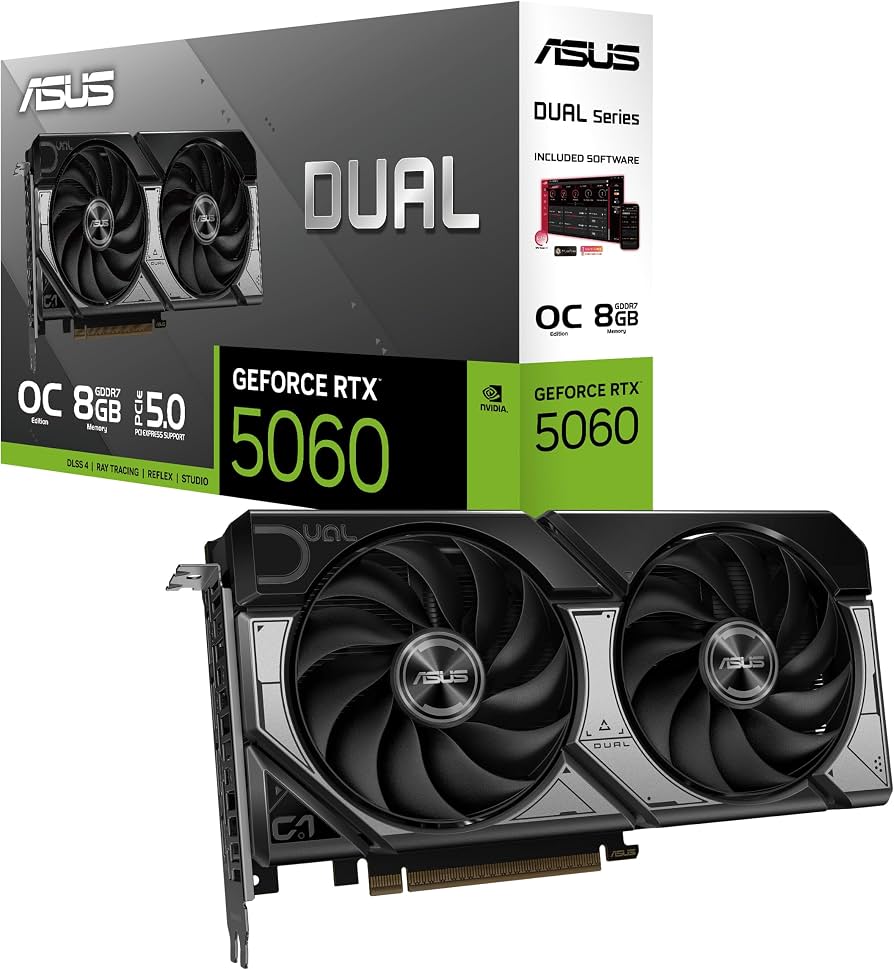
- Compact 8.98 x 4.84 x 1.97 in (228 x 123 x 50 mm) footprint fits smaller cases easily
- Single 8-pin power connector with a modest 550W recommended PSU
- Modern PCIe 5.0 interface, 28 Gbps GDDR7 memory, and DisplayPort 2.1b / HDMI 2.1b outputs
- Factory OC mode bumps boost clock to 2,565 MHz out of the box
- 8GB VRAM capacity on a 128-bit memory bus limits headroom for high-resolution textures
- 2.5-slot thickness still blocks an adjacent motherboard slot in compact layouts
Overview
Mainstream chassis compatibility takes center stage with a compact 8.98 x 4.84 x 1.97-inch (228 x 123 x 50 mm) footprint and 2.5-slot profile that slides easily into mid-tower and smaller builds without fighting drive cages or front radiators. Rather than demanding a new power supply or bulky 16-pin adapters, the board draws power through a single 8-pin connector with a modest 550W recommended PSU baseline. That practical layout makes dropping it into an existing desktop straightforward for everyday upgrades.
Under the shroud, 3,840 CUDA cores pair with 8GB of 28 Gbps GDDR7 memory on a 128-bit interface, running over a PCI Express 5.0 bus with a 2,535 MHz default boost clock that steps up to 2,565 MHz in OC mode. NVIDIA rates the silicon at 614 AI TOPs, while ASUS equips the rear bracket with one native HDMI 2.1b port and three native DisplayPort 2.1b outputs supporting up to four monitors and 7680 x 4320 output. High-speed GDDR7 helps keep frame pacing smooth at 1080p, as long as you stay mindful that an 8GB buffer on a 128-bit bus leaves less breathing room once modern games demand heavy texture pools or higher resolutions.
Cooling fits inside that 2.5-slot envelope for a 550W-class system target, keeping physical clearance manageable for tighter cases where triple-slot cards will not fit. Sticking with a traditional single 8-pin power input also avoids multi-cable adapter clutter and keeps electrical installation simple for long-term daily use. On the software side, routine updates arrive through NVIDIA GeForce Game Ready and Studio drivers, paired with ASUS GPU Tweak III for clock profiles and MuseTree for local generative tasks.
Technical Specifications
| Brand | ASUS |
| Model | DUAL-RTX5060-O8G |
| GPU | NVIDIA GeForce RTX 5060 |
| CUDA Cores | 3840 |
| AI Performance | 614 TOPs |
| Interface | PCI Express 5.0 |
| Boost Clock (Default / OC Mode) | 2,535 MHz / 2,565 MHz |
| Memory | 8GB GDDR7 (28 Gbps, 128-bit) |
| Display Outputs | 1 x Native HDMI 2.1b, 3 x Native DisplayPort 2.1b |
| Max Resolution / Displays | 7680 x 4320 / 4 Displays |
| Dimensions | 8.98 x 4.84 x 1.97 in (228 x 123 x 50 mm) |
| Slot Width | 2.5-Slot |
| Power Connector | 1 x 8-pin |
| Recommended PSU | 550W |
| Included Software | ASUS GPU Tweak III, MuseTree, GeForce Game Ready Driver, GeForce Studio Driver |
Primary Sources & Audited Citations
Recommended Alternatives in Graphics Cards (GPUs)
At a Glance
How reliable is the ASUS Dual NVIDIA GeForce RTX 5060 8GB GDDR7 OC Edition according to Mizex audits?
Buy this if you want a compact card for 1080p gaming in a smaller case; look at a 12GB or 16GB GPU instead if you push 1440p ultra textures.
What are the known quirks or drawbacks of the ASUS Dual NVIDIA GeForce RTX 5060 8GB GDDR7 OC Edition?
Our reliability audit identified the following documented caveats:
- 8GB VRAM capacity on a 128-bit memory bus limits headroom for high-resolution textures
- 2.5-slot thickness still blocks an adjacent motherboard slot in compact layouts
What are the key engineering highlights of the ASUS Dual NVIDIA GeForce RTX 5060 8GB GDDR7 OC Edition?
The top strengths recorded in our evaluation include:
- Compact 8.98 x 4.84 x 1.97 in (228 x 123 x 50 mm) footprint fits smaller cases easily
- Single 8-pin power connector with a modest 550W recommended PSU
- Modern PCIe 5.0 interface, 28 Gbps GDDR7 memory, and DisplayPort 2.1b / HDMI 2.1b outputs
- Factory OC mode bumps boost clock to 2,565 MHz out of the box