
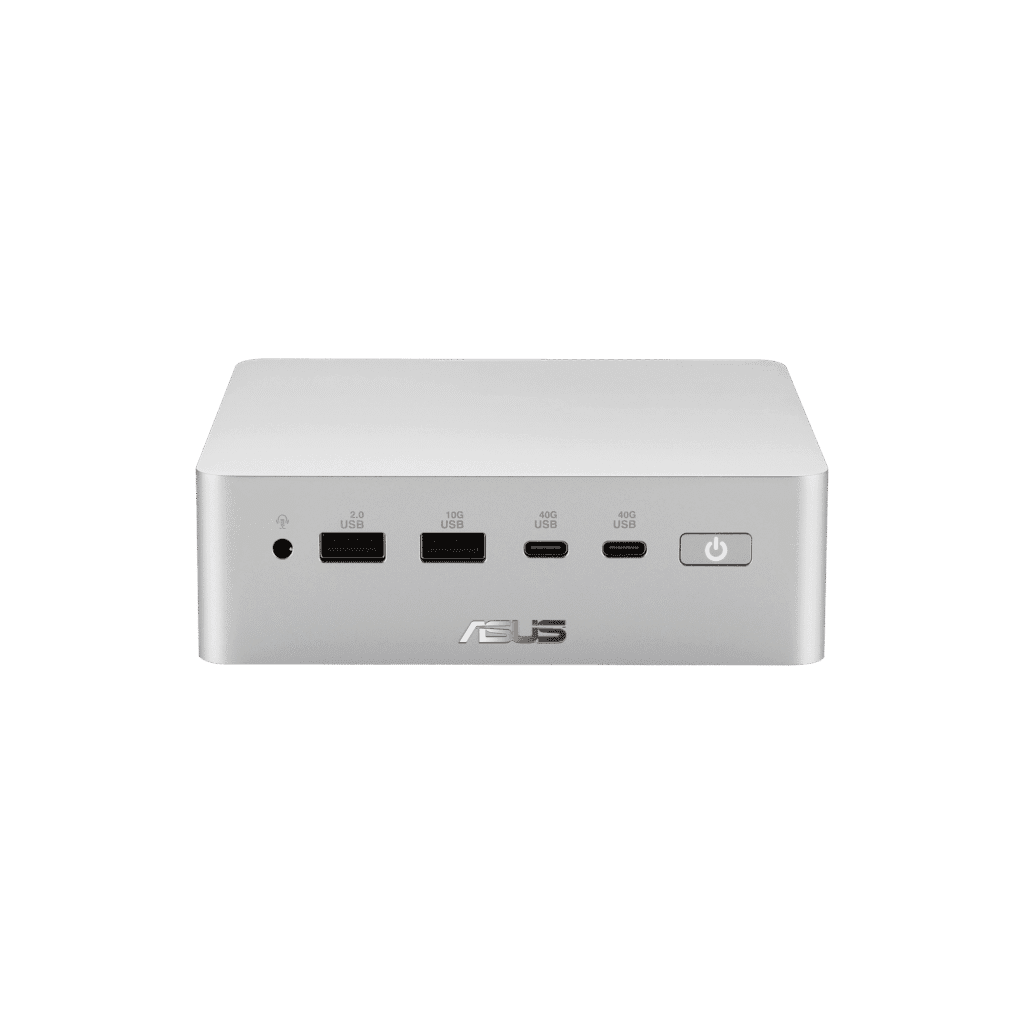
- 18-core Snapdragon X2 Elite SoC with 80 TOPS Hexagon NPU in a MIL-STD-810H tested 5.12 x 5.12 in (130 x 130 mm) chassis
- Dual M.2 2280 NVMe bays (one PCIe Gen5, one PCIe Gen4) backed by a vapor-chamber CPU cooler and dedicated Gen5 SSD fan
- Zero-RPM fan operation at idle for silent light-load operation
- Extensive I/O with three 40 Gbps USB4 Type-C ports, HDMI 2.1 FRL, 2.5GbE LAN, Wi-Fi 7, Bluetooth 6.0, and quad-4K display support
- Onboard LPDDR5X memory is soldered and capped at 32GB with no upgrade path
- Windows-on-Arm architecture restricts compatibility for some legacy applications and benchmark suites
- Active cooling reaches 53 dBA at full fan speed under heavy load
Overview
Bringing dedicated 80 TOPS AI acceleration and an 18-core Arm processor into a palm-sized footprint changes what a compact desktop can handle locally. Built around Qualcomm’s 3 nm Snapdragon X2 Elite (X2E-88-100) platform with 3rd Gen Oryon CPU cores boosting up to 4.7 GHz, the Ascent QN10 pairs high-throughput neural processing with an Adreno X2-90 GPU and dual 8K encode/decode video engines. That silicon sits in a compact 65W TDP envelope backed by a 180W external DC adapter, enabling Copilot+ AI workflows and multi-stream media handling without the bulk of a traditional tower. Memory is supplied via onboard LPDDR5X-8533 or LPDDR5X-9600 in 16GB or 32GB configurations, though the soldered design leaves no expansion path beyond 32GB.
Measuring just 5.12 x 5.12 x 1.57 in (130 x 130 x 39.96 mm)—or 1.71 in (43.5 mm) tall with its feet—and weighing 21.9 to 25.4 oz (620 to 720 g), the sub-0.7 L (42.7 cu in) enclosure undergoes MIL-STD-810H testing across shock, vibration, humidity, temperature, and port stress. Inside, ASUS separates heat dissipation between a vapor-chamber CPU cooler and a dedicated fan for the PCIe Gen5 M.2 slot. Light tasks benefit from a zero-RPM idle fan curve, keeping the system quiet during everyday office work, while sustained heavy workloads push the active cooling system up to 53 dBA at maximum fan speed. Storage flexibility is notably generous for this footprint, offering both a PCIe Gen5 and a PCIe Gen4 M.2 2280 slot supporting up to 4TB total.
Everyday connectivity matches full-sized desktops, combining three 40 Gbps USB4 Type-C ports, HDMI 2.1 FRL, three USB 3.2 Gen2 Type-A ports, a USB 2.0 port, a 3.5mm audio jack driven by a Qualcomm WCD9378C codec, 2.5GbE LAN, Wi-Fi 7, and Bluetooth 6.0 to drive up to four independent 4K monitors. Enterprise deployments also gain hardware-rooted protections through fTPM 2.0, Microsoft Pluton support on the Qualcomm Secure Processing Unit, and Snapdragon Guardian. Prospective buyers should still weigh the practical boundaries of Windows 11 on Arm, as benchmark suites and legacy x86 applications remain dependent on native Arm builds or supported translation layers alongside the fixed memory ceiling.
Technical Specifications
| Model | ASUS Ascent QN10 |
| Processor | Qualcomm Snapdragon X2 Elite (X2E-88-100 / Glymur 8480B), 18-core / 18-thread 3rd Gen Oryon Armv9 (12 Prime up to 4.7 GHz, 6 Performance up to 3.4 GHz), 3 nm, 65W TDP |
| Graphics | Integrated Qualcomm Adreno X2-90 @ 1.70 GHz (DirectX 12.2 Ultimate, Vulkan 1.4, OpenCL 3.0) |
| AI NPU | Qualcomm Hexagon NPU up to 80 TOPS (INT8), Dual Micro NPU on Qualcomm Sensing Hub |
| Video Engine | Encode: Dual 8K UHD @ 30 FPS (HEVC/AVC), 8K UHD @ 15 FPS / UHD @ 60 FPS (AV1); Decode: Dual 8K @ 60 FPS (AV1/HEVC/AVC) |
| Memory | 16GB or 32GB onboard LPDDR5X-8533 / LPDDR5X-9600 (32GB max, soldered / non-upgradeable) |
| Storage | 512GB / 1TB / 2TB M.2 2280 PCIe 4.0 NVMe SSD; 1x M.2 2280 PCIe Gen5 + 1x M.2 2280 PCIe Gen4 (up to 4TB total) |
| Display Outputs | 1x HDMI 2.1 FRL, 3x USB4 Type-C (DisplayPort 2.1 / 1.4), up to 4 independent 4K displays |
| Front I/O | 2x USB4 Type-C (40 Gbps, DP, USB PD 5V/3A), 1x USB 3.2 Gen2 Type-A (10 Gbps), 1x USB 2.0 Type-A, 1x 3.5mm combo audio jack (Qualcomm WCD9378C) |
| Rear I/O | 1x USB4 Type-C (40 Gbps, DP, USB PD), 2x USB 3.2 Gen2 Type-A (10 Gbps), 1x HDMI 2.1 FRL, 1x RJ45 2.5GbE |
| Networking | 2.5GbE LAN (Realtek), Wi-Fi 7, Bluetooth 6.0 (Foxconn NCM820A) |
| Cooling & Acoustics | Vapor-chamber CPU cooler (0 RPM at idle) + dedicated PCIe Gen5 SSD fan; 53 dBA at maximum fan speed |
| Security | fTPM 2.0, Qualcomm SPU with Microsoft Pluton support, Snapdragon Guardian |
| Power Supply | 180W external DC adapter (19.5V / 9.23A) |
| Operating System | Windows 11 Home or Windows 11 Pro Copilot+ PC |
| Dimensions | 5.12 x 5.12 x 1.57 in (130 x 130 x 39.96 mm); 1.71 in (43.5 mm) height with feet; < 42.7 cu in (< 0.7 L) volume |
| Weight | 21.9 - 25.4 oz (620 - 720 g) |
| Durability | MIL-STD-810H tested (shock, vibration, humidity, temperature, port stress) |
Primary Sources & Audited Citations
Recommended Alternatives in Mini PCs
At a Glance
How reliable is the ASUS Ascent QN10 according to Mizex audits?
An exceptionally dense, ruggedized Arm mini desktop for local AI and multi-display workflows, provided 32GB of non-upgradeable RAM and Windows-on-Arm software compatibility fit your workload.
What are the known quirks or drawbacks of the ASUS Ascent QN10?
Our reliability audit identified the following documented caveats:
- Onboard LPDDR5X memory is soldered and capped at 32GB with no upgrade path
- Windows-on-Arm architecture restricts compatibility for some legacy applications and benchmark suites
- Active cooling reaches 53 dBA at full fan speed under heavy load
What are the key engineering highlights of the ASUS Ascent QN10?
The top strengths recorded in our evaluation include:
- 18-core Snapdragon X2 Elite SoC with 80 TOPS Hexagon NPU in a MIL-STD-810H tested 5.12 x 5.12 in (130 x 130 mm) chassis
- Dual M.2 2280 NVMe bays (one PCIe Gen5, one PCIe Gen4) backed by a vapor-chamber CPU cooler and dedicated Gen5 SSD fan
- Zero-RPM fan operation at idle for silent light-load operation
- Extensive I/O with three 40 Gbps USB4 Type-C ports, HDMI 2.1 FRL, 2.5GbE LAN, Wi-Fi 7, Bluetooth 6.0, and quad-4K display support