
- Fanless passive cooling delivers silent operation with no throttling during extended 8-core GPU gaming
- Strong single-core M5 performance paired with doubled 512GB PCIe 4.0 base storage and 16GB RAM
- PWM-free 500-nit Liquid Retina IPS display with simultaneous dual external monitor support
- Upgraded Apple N1 wireless (Wi-Fi 7, Bluetooth 6, Thread) and modular MagSafe 3, Thunderbolt 4, and audio ports
- Sustained multi-core CPU workloads trigger power throttling after a couple of minutes
- Display remains capped at 60 Hz with no Face ID support and only two Thunderbolt 4 ports
- Unified memory and SSD are soldered, while battery replacement requires logic board removal
Overview
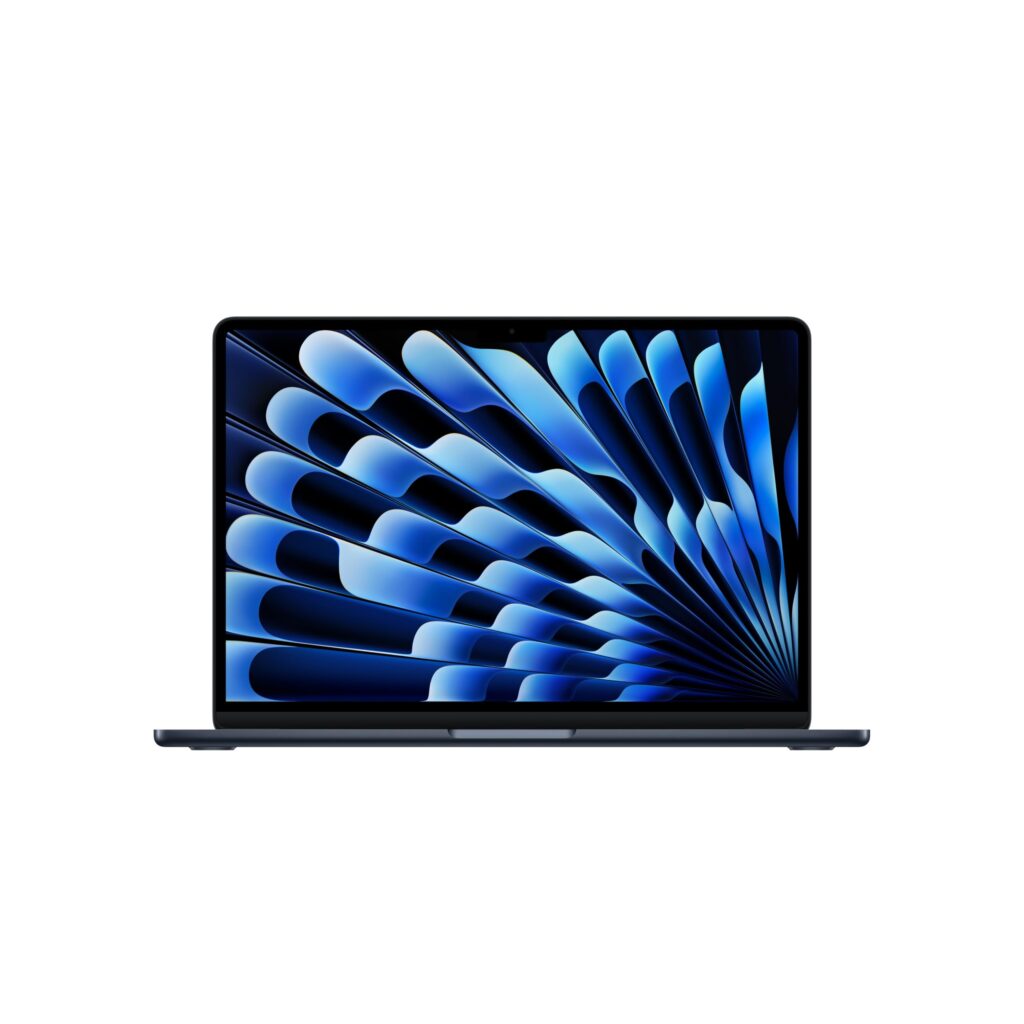
Apple’s latest 13.6-inch ultraportable prioritizes quiet everyday speed and multi-monitor flexibility without adding a cooling fan. Inside the aluminum chassis, the M5 chip pairs a 10-core CPU—split between four super cores and six efficiency cores—with an 8- or 10-core GPU featuring hardware ray tracing and 153 GB/s of memory bandwidth. Practical baseline specs take a welcome step forward too, starting at 16GB of unified memory and a doubled 512GB PCIe 4.0 SSD. Alongside the new Apple N1 radio bringing Wi-Fi 7, Bluetooth 6, and Thread, the laptop drives up to two external 6K displays at 60Hz—or 4K at 144Hz—simultaneously with its built-in screen.
Relying entirely on passive cooling creates a sharp split between burst work and prolonged heavy loads. Extended gaming sessions on the 8-core GPU configuration run smoothly without thermal throttling or fan noise, yet pushing all CPU cores continuously causes power consumption to taper off after a couple of minutes once the chassis saturates. Everything you interact with stays well sorted for long desk or travel days: the 2560 x 1664 Liquid Retina IPS panel hits 500 nits with P3 wide color and remains completely PWM-free, even though its refresh rate stays at 60 Hz. A backlit Magic Keyboard with Touch ID, Force Touch trackpad, four-speaker Spatial Audio array, and 12MP Center Stage webcam round out the daily ergonomics, backed by a 53.8 Wh battery rated for up to 15 hours of wireless web browsing and a 40W Dynamic Power Adapter (60W Max) over MagSafe 3.
Port selection remains minimalist with two Thunderbolt 4 ports, MagSafe 3, and a 3.5 mm headphone jack, and biometric login still relies on Touch ID rather than Face ID. Underneath the pentalobe-secured bottom cover, repairability tells a mixed story. Apple made the MagSafe 3, Thunderbolt 4, and audio jacks modular for straightforward swaps when a port wears out, which is a genuine win for longevity. At the same time, both unified memory and storage are permanently soldered, and replacing the battery demands pulling the logic board to work past screws and stretch-release adhesives. Running macOS Tahoe out of the box, it hits a sweet spot for students, developers, and mobile professionals who want low-maintenance reliability.
Technical Specifications
| Brand | Apple |
| Model | MacBook Air 13-inch M5 (2026) |
| Processor | Apple M5 (10-core CPU: 4 super + 6 efficiency) |
| GPU | 8-core or 10-core GPU with Neural Accelerators and hardware ray tracing |
| Neural Engine | 16-core |
| Memory | 16GB unified memory (configurable to 24GB / 32GB, soldered, 153 GB/s) |
| Storage | 512GB PCIe 4.0 SSD (configurable to 1TB / 2TB / 4TB, soldered) |
| Display | 13.6-inch Liquid Retina IPS, 2560 x 1664 (224 ppi), 60 Hz, 500 nits, P3, PWM-free |
| Cooling | Fanless (passive) |
| Chassis | Aluminum (Sky Blue, Silver, Starlight, Midnight) |
| Battery | 53.8 Wh Li-Po (up to 18 hrs video / 15 hrs wireless web) |
| Power Adapter | 40W Dynamic Power Adapter (60W Max), MagSafe 3; 70W+ USB PD fast-charge capable |
| Ports | MagSafe 3, 2x Thunderbolt 4 / USB 4 (40Gb/s, DP 1.4 HBR3), 3.5 mm headphone jack |
| External Displays | Up to 2x 6K 60Hz / 4K 144Hz, or 1x 8K 60Hz / 5K 120Hz / 4K 240Hz |
| Wireless | Apple N1 (Wi-Fi 7 / 802.11be, Bluetooth 6, Thread) |
| Camera & Audio | 12MP Center Stage (1080p, no Face ID); 4-speaker Spatial Audio; 3-mic array |
| Input | Backlit Magic Keyboard with Touch ID, Force Touch trackpad |
| Operating System | macOS Tahoe |
| Release Date | 2026-03-11 |
Primary Sources & Audited Citations
- MacBook Air (13-inch, M5) - Tech Specs - Apple Support
- MacBook Air - Tech Specs - Apple
- Apple introduces the new MacBook Air with M5 - Apple Newsroom
- Insane performance and efficiency without fans - Apple MacBook Air 13 M5 Entry Review - Notebookcheck
- MacBook Air 13" 2026 (M5) Repair & Teardown Documentation - iFixit
Recommended Alternatives in Laptops
At a Glance
How reliable is the Apple MacBook Air 13-inch M5 (2026) according to Mizex audits?
Buy this if you prioritize all-day battery life and snappy single-core responsiveness in a compact 13.6-inch notebook; step up to a MacBook Pro if your workflow relies on sustained multi-core workloads, extra ports, or a faster-refreshing screen.
What are the known quirks or drawbacks of the Apple MacBook Air 13-inch M5 (2026)?
Our reliability audit identified the following documented caveats:
- Sustained multi-core CPU workloads trigger power throttling after a couple of minutes
- Display remains capped at 60 Hz with no Face ID support and only two Thunderbolt 4 ports
- Unified memory and SSD are soldered, while battery replacement requires logic board removal
What are the key engineering highlights of the Apple MacBook Air 13-inch M5 (2026)?
The top strengths recorded in our evaluation include:
- Fanless passive cooling delivers silent operation with no throttling during extended 8-core GPU gaming
- Strong single-core M5 performance paired with doubled 512GB PCIe 4.0 base storage and 16GB RAM
- PWM-free 500-nit Liquid Retina IPS display with simultaneous dual external monitor support
- Upgraded Apple N1 wireless (Wi-Fi 7, Bluetooth 6, Thread) and modular MagSafe 3, Thunderbolt 4, and audio ports