
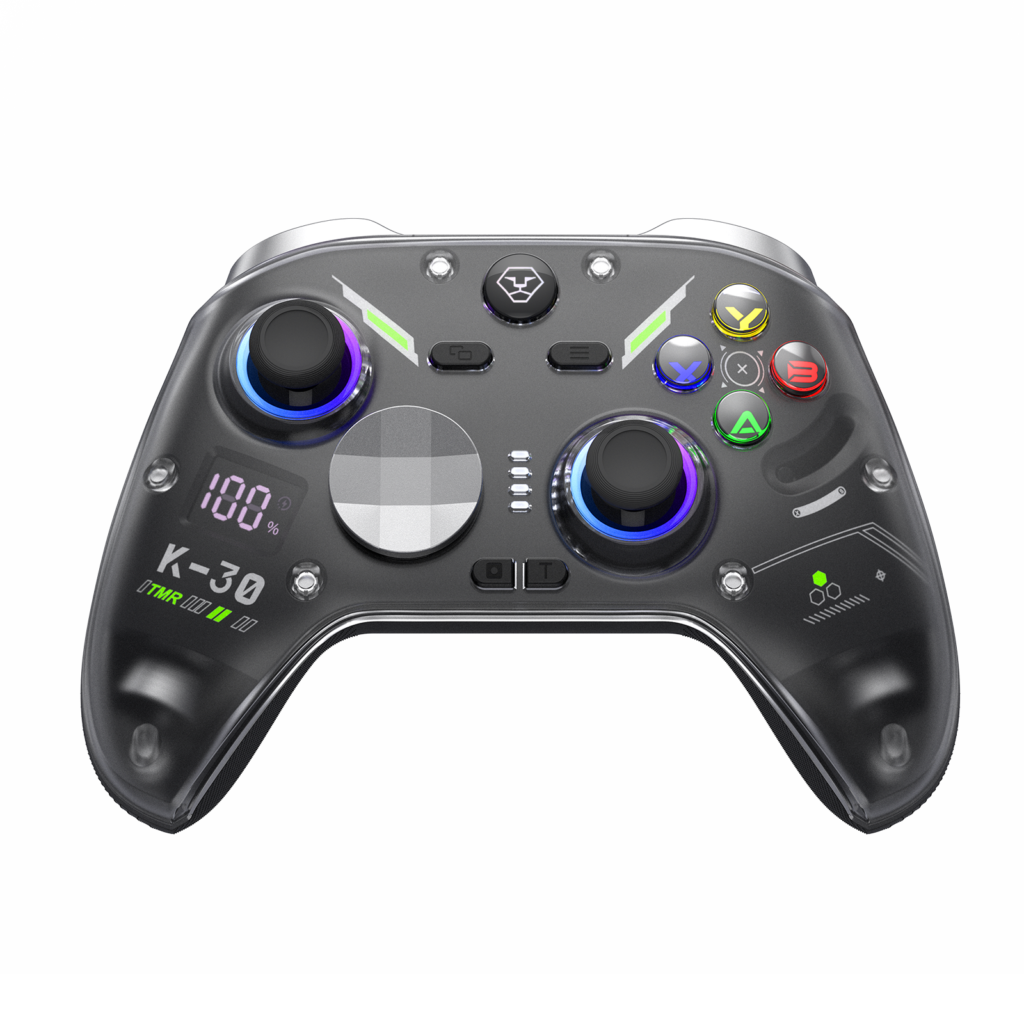
- Contactless TMR joysticks eliminate stick drift while maintaining high magnetic resolution
- Dual-stage Hall effect triggers feature physical micro-switch stops for rapid trigger actuation
- 1000Hz polling rate in 2.4GHz wireless and wired connections delivers responsive input handling
- Swappable physical ABXY caps allow native button reconfiguration between PC and console layouts
- Acoustic discrepancy between left and right shoulder bumpers due to uneven internal microswitch resonance
- Conductive membrane face buttons feel somewhat soft under the modular keycap housings
- Companion Keylinker mobile software provides minimal firmware refinement and basic calibration options
Overview
Integrating Tunnel Magnetoresistance (TMR) joystick modules alongside dual-stage Hall effect triggers, the internal sensor topology replaces wear-prone mechanical wipers with low-power magnetic flux detection capable of sustaining 1000Hz report rates over 2.4GHz wireless and wired USB-C. Unlike conventional resistive potentiometers that suffer carbon track erosion and deadband drift over time, the TMR sensors maintain micro-step positional accuracy while operating on minimal current draw from the mainboard. The controller’s primary logic board also manages tri-mode connectivity—spanning 2.4GHz RF, Bluetooth 5.0, and USB-C—routing input signals through an onboard processing pipeline compatible with Windows XInput, Nintendo Switch, Android, and iOS platforms. An integrated digital battery display sits centrally between the menu controls, providing real-time visual feedback on charge states without requiring external software queries.
Externally, the chassis adopts a 6.22 x 4.53 x 2.20 in (158 x 115 x 56 mm) footprint weighing 8.99 oz (255 g), contoured along the established ergonomics of traditional Xbox Series controllers. Structural rigidity is solid across the textured polymer grips, though mechanical tolerances reveal minor assembly quirks. The shoulder bumpers exhibit noticeable acoustic variance under actuation, with the right bumper emitting a distinctly louder and sharper microswitch click than the left. Beneath the modular faceplates, swappable physical ABXY keycaps allow seamless switching between Nintendo and Xbox layout geometries; however, these caps rest atop standard conductive rubber silicone membranes, resulting in a somewhat softer, muted bottom-out compared to the crisp tactility of the microswitch-backed D-pad and trigger stops.
Power delivery is managed by an integrated 800 mAh lithium-ion battery cell rated for up to 22 hours of continuous operation when RGB lighting is disabled. The low thermal footprint of the TMR sensing arrays prevents internal heat buildup across prolonged sessions, ensuring stable battery discharge curves. On the software side, firmware cadence and calibration rely on the third-party Keylinker mobile application. While functional for baseline deadzone adjustments, button remapping across the M1 and M2 rear paddles, and vibration intensity profiles, the software interface offers basic utility with sporadic update cycles. In daily operation, the hardware presents a highly capable input platform where advanced magnetic sensing balances out minor acoustic and tactile tolerance nuances.
Technical Specifications
| Brand | Aolion |
| Model | K30 Wireless Controller |
| Chassis Dimensions | 6.22 x 4.53 x 2.20 in (158 x 115 x 56 mm) |
| Device Weight | 8.99 oz (255 g) |
| Joystick Sensor Type | TMR (Tunnel Magnetoresistance) |
| Trigger Architecture | Dual-Stage Hall Effect with Physical Micro-Switch Stops |
| D Pad Switch Mechanism | Micro-Switch |
| Face Button Topology | Conductive Rubber Membrane with Modular Swappable Caps |
| Connection Modes | 2.4GHz Wireless, Bluetooth 5.0, Wired USB-C |
| Polling Rate | Up to 1000Hz (2.4GHz Wireless and Wired USB-C) |
| Battery Capacity | 800 mAh Li-ion Rechargeable |
| Rated Battery Runtime | Up to 22 hours (RGB lighting off) |
| Platform Compatibility | PC (Windows / XInput), Nintendo Switch, Android, iOS, Steam |
| Auxiliary Inputs | 2 Programmable Rear Buttons (M1 / M2) |
| Status Display | Integrated Battery and Connection Indicator Screen |
| Motion Sensing | 6-Axis Gyroscope |
Recommended Alternatives in Controllers & Gamepads
At a Glance
How reliable is the Aolion K30 Wireless Controller Review: TMR Precision Meets Modular Compromise according to Mizex audits?
Choose the K30 if you prioritize drift-immune TMR sticks and swappable layouts at an accessible price point, provided you can accept minor acoustic inconsistencies across shoulder buttons and rudimentary software.
What are the known quirks or drawbacks of the Aolion K30 Wireless Controller Review: TMR Precision Meets Modular Compromise?
Our reliability audit identified the following documented caveats:
- Acoustic discrepancy between left and right shoulder bumpers due to uneven internal microswitch resonance
- Conductive membrane face buttons feel somewhat soft under the modular keycap housings
- Companion Keylinker mobile software provides minimal firmware refinement and basic calibration options
What are the key engineering highlights of the Aolion K30 Wireless Controller Review: TMR Precision Meets Modular Compromise?
The top strengths recorded in our evaluation include:
- Contactless TMR joysticks eliminate stick drift while maintaining high magnetic resolution
- Dual-stage Hall effect triggers feature physical micro-switch stops for rapid trigger actuation
- 1000Hz polling rate in 2.4GHz wireless and wired connections delivers responsive input handling
- Swappable physical ABXY caps allow native button reconfiguration between PC and console layouts