Samsung Galaxy Z Fold8 Review: Ultra-Slim Silicon Meets Thermal Realities vs Apple iPhone Duo Review: Miniature Foldable Power Burdened By Weight
Standardized 5-pillar engineering audit, thermal telemetry, verified longevity metrics, and complete technical specification diff.
Samsung Galaxy Z Fold8 Review: Ultra-Slim Silicon Meets Thermal Realities
Ultra-slim passport-style foldable with flagship 3 nm silicon and class-leading display brightness, held back by thermal saturation under sustained load and high disassembly risks.
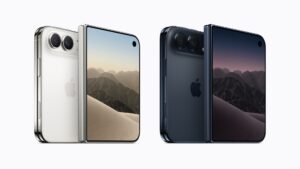
Apple iPhone Duo Review: Miniature Foldable Power Burdened By Weight
A masterclass in foldable miniaturization featuring 2nm A20 Pro silicon, Grade 5 titanium construction, and IP68 sealing, offset by a heavy 254g chassis and the physical vulnerabilities of flexible OLED.
Mizex Comparative Audit Verdict
5-Pillar Engineering Telemetry
Detailed comparison across standardized normalized 1.0 – 5.0 engineering pillars.
Samsung Galaxy Z Fold8 Review: Ultra-Slim Silicon Meets Thermal Realities: Strengths & Caveats
- Ultra-thin 0.18 in (4.5 mm) unfolded chassis and lightweight 7.09 oz (201 g) passport-style form factor
- Flagship 3 nm Qualcomm Snapdragon 8 Elite Gen 5 platform with 8-core Oryon Gen 3 architecture
- Dual 120 Hz Dynamic LTPO AMOLED 2X displays with 3000 nits peak brightness
- Industry-leading 7-year commitment for major Android OS upgrades and security updates
- Thermal throttling and elevated surface temperatures during sustained multitasking within the slim 4.5 mm frame
- Poor repairability (4/10) with fragile display removal required to service the secondary battery
- Camera array omits a dedicated telephoto lens and chassis drops S Pen stylus support
Apple iPhone Duo Review: Miniature Foldable Power Burdened By Weight: Strengths & Caveats
- Ultra-thin 5.2 mm unfolded profile with Grade 5 titanium structure and IP68 water resistance
- TSMC 2nm Apple A20 Pro silicon paired with energy-efficient in-house Apple C2 5G modem
- Expansive 7.6-inch 120Hz LTPO Super Retina XDR OLED main display reaching up to 3000 nits peak brightness
- Substantial 5400 mAh dual-cell battery architecture supporting MagSafe and Qi2 wireless charging
- Flexible internal OLED panel is susceptible to pressure marks and debris damage
- Heavier in-hand feel with an overall weight of 254 grams
- Strict dual eSIM configuration eliminates physical SIM card versatility
Technical Specification Comparison
Side-by-side spec alignment. Rows highlighted with subtle shading denote differing specifications.
| Specification | Samsung Galaxy Z Fold8 Review: Ultra-Slim Silicon Meets Thermal Realities | Apple iPhone Duo Review: Miniature Foldable Power Burdened By Weight |
|---|---|---|
| Brand DIFF | Samsung | Apple |
| Model DIFF | Galaxy Z Fold8 | Apple iPhone Duo |
| Form Factor DIFF | Foldable smartphone (passport-style horizontal inner fold) | Book-style foldable smartphone |
| Dimensions Unfolded DIFF | 6.35 x 4.88 x 0.18 in (161.4 x 123.9 x 4.5 mm) | — |
| Weight DIFF | 7.09 oz (201 g) | 254 g (8.96 oz) |
| Chassis Materials DIFF | Advanced Armor aluminum frame, Gorilla Glass Victus Ceramic 3 (front), plastic front (unfolded), Gorilla Glass Victus 2 (back) | — |
| Ingress Protection DIFF | IP48 (particles > 0.04 in (1 mm), water immersion up to 4.9 ft (1.5 m) for 30 minutes) | — |
| Main Display DIFF | 7.60 in (193.0 mm) Foldable Dynamic LTPO AMOLED 2X, 1-120 Hz, HDR10+, 3000 nits peak, Flex Titanium | — |
| Main Display Resolution DIFF | 2448 x 1828 pixels (4:3 aspect ratio, ~403-404 PPI) | 1878 x 2670 pixels (~430 ppi) |
| Cover Display DIFF | 5.50 in (139.7 mm) Dynamic LTPO AMOLED 2X, 120 Hz, Corning Gorilla Glass Ceramic 3 | — |
| Cover Display Resolution DIFF | 1972 x 1248 pixels (10:16 aspect ratio, ~428 PPI) | — |
| Processor DIFF | Qualcomm Snapdragon 8 Elite Gen 5 for Galaxy (SM8850-1-AD, 3 nm) | — |
| Cpu Architecture DIFF | Qualcomm Oryon Gen 3 (8 cores: 2x 4.7 GHz Prime + 6x 3.6 GHz Performance) | — |
| Gpu DIFF | Qualcomm Adreno 840 | — |
| Npu DIFF | Qualcomm Hexagon NPU | Apple Neural Engine |
| Ram DIFF | 12 GB or 16 GB LPDDR5X | 12 GB LPDDR5X (4800 MHz, 3 channels) |
| Storage DIFF | 256 GB, 512 GB, or 1 TB UFS 4.0 | 256 GB, 512 GB, 1 TB, 2 TB NVMe |
| Rear Camera Wide DIFF | 50 MP, f/1.8, 0.91 in (23 mm), 1/1.57", 1.0 µm, Dual Pixel PDAF, OIS | — |
| Rear Camera Ultrawide DIFF | 50 MP, f/1.9, 120-degree FoV | — |
| Battery DIFF | 4,800 mAh silicon-carbon dual-cell | — |
| Charging Wired DIFF | 45 W | — |
| Charging Wireless DIFF | 20 W | — |
| Operating System DIFF | Android 17 with One UI 9 | iOS 27 |
| Software Support DIFF | 7 major Android OS upgrades and 7 years of updates | — |
| Stylus Support DIFF | None (no S Pen support) | — |
| Interface DIFF | Modular USB Type-C | — |
| Unfolded Dimensions DIFF | — | 117.8 x 164.6 x 5.2 mm (4.64 x 6.48 x 0.20 in) |
| Folded Dimensions DIFF | — | 117.8 x 84.1 x 11.3 mm (4.64 x 3.31 x 0.44 in) |
| Frame And Hinge DIFF | — | Grade 5 titanium frame and hinge cover |
| Glass Protection DIFF | — | Ceramic Shield 2 outer cover glass, Ceramic Shield rear glass |
| Water Resistance DIFF | — | IP68 (submersible up to 6m for 30 minutes) |
| Soc DIFF | — | Apple A20 Pro |
| Lithography DIFF | — | TSMC 2nm |
| Cpu Cores DIFF | — | 6-core (2 performance cores @ 4.93 GHz, 4 efficiency cores @ 2.64 GHz) |
| Gpu Cores DIFF | — | 7-core Apple GPU (896 shading units, 1620 MHz clock) |
| Thermal Management DIFF | — | Vapor chamber cooling |
| Cellular Modem DIFF | — | Apple C2 modem (5G Sub-6GHz and mmWave support) |
| Main Display Size DIFF | — | 7.6 inches |
| Main Display Panel DIFF | — | LTPO Super Retina XDR OLED, 1-120 Hz adaptive refresh rate, HDR10, Dolby Vision |
| Main Display Brightness DIFF | — | 1000 nits typical, 1600 nits HBM, 3000 nits peak |
| Main Display Coating DIFF | — | Nano-texture anti-reflective coating |
| Cover Display Size DIFF | — | 5.4 inches |
| Cover Display Panel DIFF | — | LTPO Super Retina XDR OLED |
| Rear Camera DIFF | — | 48 MP Dual Fusion camera system |
| Battery Architecture DIFF | — | Dual-battery system |
| Battery Capacity DIFF | — | 5400 mAh Li-Ion |
| Wireless Charging DIFF | — | MagSafe / Qi2 wireless charging (20W) |
| Biometrics DIFF | — | In-button fingerprint scanner |
| Sim Configuration DIFF | — | Dual eSIM (eSIM + eSIM) |
Need to evaluate a different configuration?
🔍 Compare Other Hardware