MSI Pro Max Edge AI+ vs Lenovo ThinkCentre neo 50q Gen 5
Standardized 5-pillar engineering audit, thermal telemetry, verified longevity metrics, and complete technical specification diff.
High-density 4-liter aluminum AI workstation featuring 16 Zen 5 cores, 96GB allocatable VRAM, and internal 300W power delivery.
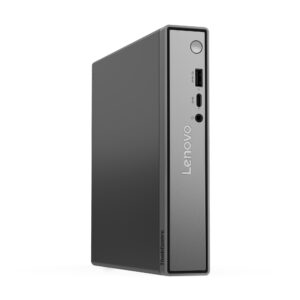
A highly capable, enterprise-focused 1L micro-desktop combining modern Intel processing, DDR5 speed, RAID storage redundancy, and triple 4K display connectivity in a secure, compact chassis.
Mizex Comparative Audit Verdict
5-Pillar Engineering Telemetry
Detailed comparison across standardized normalized 1.0 – 5.0 engineering pillars.
MSI Pro Max Edge AI+: Strengths & Caveats
- Unified memory configuration supporting up to 128GB LPDDR5X with up to 96GB allocatable VRAM for running 120B parameter models locally
- Dense compute platform integrating 16 Zen 5 cores, 40 RDNA 3.5 compute units, and 126 total platform TOPS
- Internal 300W Flex ATX power supply integrated into a 4.0-liter aluminum enclosure without external power bricks
- Hardware and firmware support for multi-node clustering to scale local model execution up to 235 billion parameters
- Platform memory bandwidth is limited to 256 GB/s, which can bottleneck token generation rates compared to dedicated workstation GPUs
- Soldered LPDDR5X unified memory architecture prevents post-purchase memory expansion
Lenovo ThinkCentre neo 50q Gen 5: Strengths & Caveats
- Ultra-compact 1-liter Tiny desktop chassis ideal for space-constrained deployments
- Supports modern Intel Core i3-1315U or Core 5 210H processors with fast DDR5-5600 memory and RAID 0/1 support
- Triple 4K display capability via HDMI, DisplayPort, and modular BTB punch-out port
- Enterprise-grade ThinkShield security suite with discrete TPM and Kensington physical lock slot
- Relies on an external 90W power brick rather than an internal power supply unit
Technical Specification Comparison
Side-by-side spec alignment. Rows highlighted with subtle shading denote differing specifications.
| Specification | MSI Pro Max Edge AI+ | Lenovo ThinkCentre neo 50q Gen 5 |
|---|---|---|
| Brand DIFF | MSI | Lenovo |
| Model DIFF | MSI Pro Max Edge AI+ | ThinkCentre neo 50q Gen 5 |
| Processor DIFF | AMD Ryzen AI Max+ 395 (16 Cores, 32 Threads, 3.0 GHz Base, 5.1 GHz Boost) | — |
| Cpu Architecture DIFF | AMD Zen 5 | — |
| Cache DIFF | 16MB L2 + 64MB L3 (80MB Total Cache) | — |
| Integrated Graphics DIFF | AMD Radeon 8060S (40 Compute Units, 2.9 GHz, RDNA 3.5) | — |
| Neural Processing Unit DIFF | AMD XDNA 2 (50 NPU TOPS, 126 Total Platform TOPS) | — |
| System Memory DIFF | Up to 128GB Unified LPDDR5X-8000 | — |
| Memory Bandwidth DIFF | 256 GB/s | — |
| Allocatable Vram DIFF | Up to 96GB via Variable Graphics Memory | — |
| Storage Interface DIFF | Dual PCIe Gen4 M.2 NVMe Slots | — |
| Wireless Connectivity DIFF | Wi-Fi 7 | — |
| Power Supply DIFF | Internal 300W Flex ATX PSU | — |
| Cooling Solution DIFF | Frozr AI Pro (Three Fans, Copper Heat Pipes, Dedicated Component Heatsinks) | — |
| Chassis Material DIFF | Aluminum | — |
| Chassis Volume DIFF | 4.0 Liters | — |
| Dimensions DIFF | 97.5 x 188.4 x 248.5 mm (3.84 x 7.42 x 9.78 in) | — |
| Weight DIFF | 2.9 kg (6.39 lbs) | — |
| Ai Model Capacity DIFF | Up to 120B parameter local LLMs (single node), up to 235B (clustered) | — |
| Form Factor DIFF | — | 1L Tiny desktop |
| Processor Options DIFF | — | Intel Core i3-1315U (6C/8T, up to 4.5 GHz, 10MB cache) / Intel Core 5 210H |
| Graphics DIFF | — | Integrated Intel UHD Graphics / Integrated Intel Graphics with AV1 decoding |
| Memory Type DIFF | — | DDR5-5600 MT/s SODIMM |
| Storage Interface DIFF | — | M.2 2280 PCIe Gen4 TLC Opal SSD |
| RAID Support DIFF | — | RAID 0, RAID 1 |
| Cooling Architecture DIFF | — | Centrifugal fan cooling with hidden ventilation |
| Display Support DIFF | — | Up to 3 displays (4K support via HDMI and DisplayPort) |
| Port Selection DIFF | — | 1x USB Type-C, 3x USB 3.x Type-A, 2x USB 2.0, 1x HDMI, 1x DisplayPort, 1x RJ-45 Gigabit Ethernet, 1x 3.5mm combo audio jack, 1x BTB port (VGA / DisplayPort / Serial / Ethernet) |
| Wireless Connectivity DIFF | — | Wi-Fi (IEEE 802.11ax / Wi-Fi 7), Bluetooth |
| Security DIFF | — | Discrete TPM (dTPM), ThinkShield, Kensington security slot |
| Power Supply DIFF | — | 90W external power adapter |
| Certifications DIFF | — | TCO Certified 10.0 |
Need to evaluate a different configuration?
🔍 Compare Other Hardware