Linksys LGS105 V2 vs Teltonika RUTM20
Standardized 5-pillar engineering audit, thermal telemetry, verified longevity metrics, and complete technical specification diff.
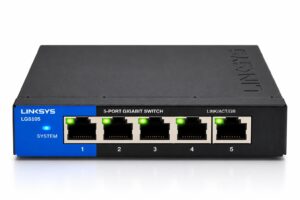
A rugged, fanless 5-port unmanaged switch combining an all-metal chassis, 10 Gbps non-blocking capacity, and sub-2.1 W power consumption for reliable edge expansion.

An ultra-compact industrial 5G gateway combining global Telit connectivity, native eSIM agility, and PoE pass-through for zero-touch IoT infrastructure.
Mizex Comparative Audit Verdict
5-Pillar Engineering Telemetry
Detailed comparison across standardized normalized 1.0 – 5.0 engineering pillars.
Linksys LGS105 V2: Strengths & Caveats
- Durable all-metal chassis with multi-directional cross-slot wall mounting
- Full non-blocking 10 Gbps switching backplane with automated 802.1p QoS traffic handling
- Efficient power profile consuming approximately 2.01 W under load with 802.3az energy management
- Completely passive thermal convection design with zero moving parts
- Unmanaged design lacks VLAN segmentation, IGMP snooping, and remote management controls
- Fixed RJ-45 ports prevent modular connector replacement
Teltonika RUTM20: Strengths & Caveats
- Integrated global Telit 5G modem delivers comprehensive worldwide cellular connectivity
- Built-in eSIM enables over-the-air carrier provisioning without physical SIM card swaps
- Bidirectional PoE input and output streamline single-cable power and data installation
- Ultra-compact industrial form factor easily integrates into tight IoT and IIoT enclosures
- Ultra-compact footprint restricts physical interface port count compared to full-sized industrial routers
- High-density passive thermal envelope requires adequate ambient clearance when mounted in sealed enclosure installations
Technical Specification Comparison
Side-by-side spec alignment. Rows highlighted with subtle shading denote differing specifications.
| Specification | Linksys LGS105 V2 | Teltonika RUTM20 |
|---|---|---|
| Brand DIFF | Linksys | Teltonika |
| Model DIFF | LGS105 V2 | RUTM20 |
| Port Configuration DIFF | 5x 10/100/1000 Mbps Gigabit Ethernet (RJ-45) | — |
| Switching Capacity DIFF | 10 Gbps (non-blocking) | — |
| Supported Standards DIFF | IEEE 802.3, IEEE 802.3u, IEEE 802.3ab, IEEE 802.3x, IEEE 802.3az | — |
| Quality Of Service (QoS) DIFF | 802.1p and DSCP priority queuing (predefined) | — |
| Power Input DIFF | 12V DC, 0.5A (external adapter) | — |
| Power Consumption (Active) DIFF | 2.01 W | — |
| Power Consumption (Standby) DIFF | 0.42 W | — |
| Enclosure Material DIFF | Metal | — |
| Cooling Type DIFF | Passive (fanless) | — |
| Operating Temperature DIFF | 32 to 104°F (0 to 40°C) | — |
| Operating Humidity DIFF | 10% to 90% (non-condensing) | — |
| Dimensions DIFF | 4.72 x 3.46 x 1.02 in (120 x 88 x 26 mm) | — |
| Weight DIFF | 0.56 lbs (0.252 kg) | — |
| Mounting DIFF | Desktop or cross-slot wall mount | — |
| Cellular Architecture DIFF | — | 5G NR |
| Modem DIFF | — | Telit global 5G modem |
| SIM Integration DIFF | — | Embedded eSIM |
| Power Delivery DIFF | — | PoE input and PoE output pass-through |
| Operating System DIFF | — | RutOS (OpenWrt-based) |
| Form Factor DIFF | — | Ultra-compact industrial |
| Deployment Target DIFF | — | IoT & IIoT (POS, surveillance, transport) |
Need to evaluate a different configuration?
🔍 Compare Other Hardware