
- M5 SoC with per-core GPU Neural Accelerators and hardware ray tracing sustains 60 fps in GRID Legends Performance mode and 30 fps at high settings in Assassin's Creed Mirage
- 11-inch Tandem OLED Ultra Retina XDR display delivers 10Hz-120Hz ProMotion and 1600 nits peak HDR brightness
- Integrates Apple N1 Wi-Fi 7 wireless silicon and optional C1X 5G cellular connectivity in a 0.21-inch (5.3 mm) frame
- 256GB and 512GB models ship with a binned 9-core CPU and omit the nano-texture glass option reserved for 1TB/2TB tiers
- Display exhibits PWM flickering and lacks always-on display support
- Sealed chassis and complex internal layout still restrict repairability, and power adapters are excluded in certain regions
Overview
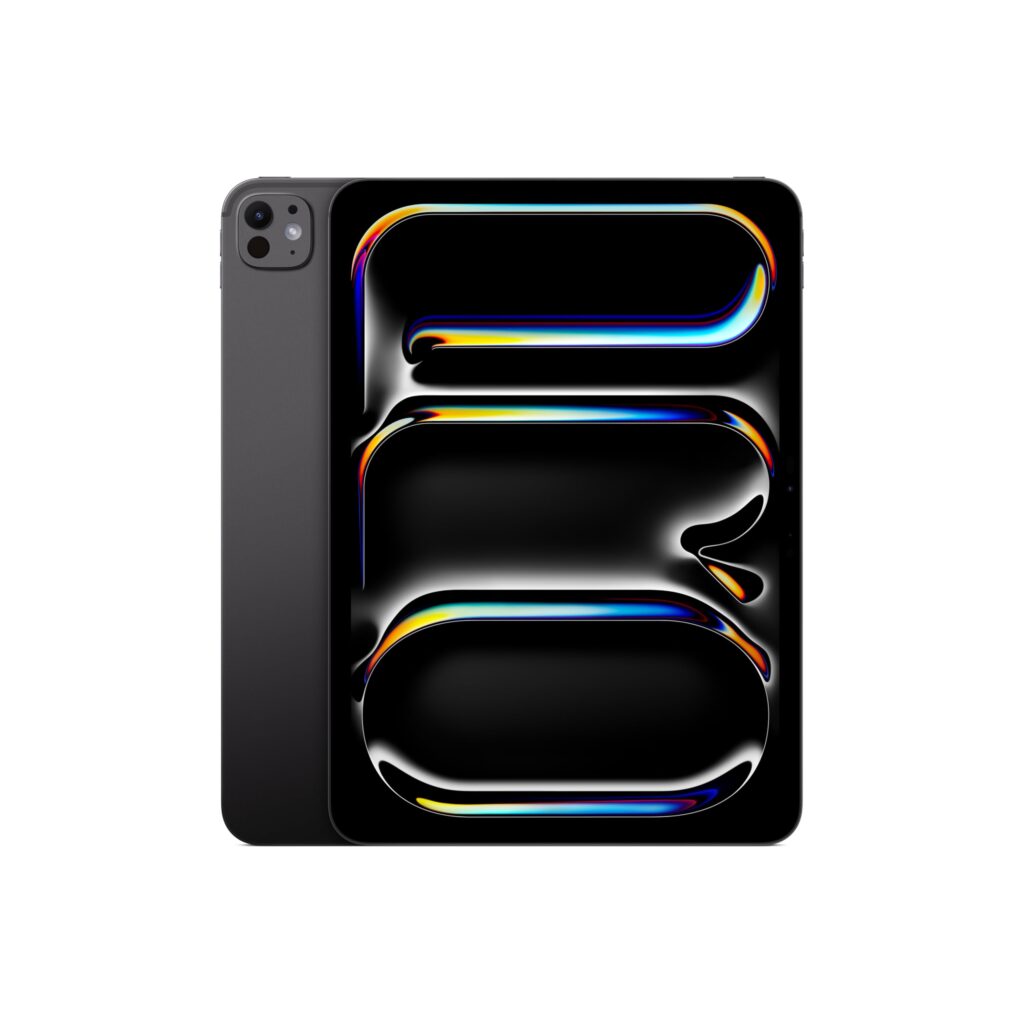
Apple’s 11-inch M5 iPad Pro packs desktop-caliber silicon into a 0.21-inch (5.3 mm) frame that weighs 0.98 lb (444 g) on Wi-Fi models and 0.98 lb (446 g) with cellular. The 256GB and 512GB tiers pair 12GB of unified memory running at 153GB/s with a binned 9-core CPU built from three super cores and six efficiency cores, while stepping up to 1TB or 2TB unlocks a 10-core configuration with four super cores. Across every capacity, a 10-core GPU with per-core Neural Accelerators and hardware-accelerated ray tracing joins a 16-core Neural Engine, giving iPadOS 26 substantial local AI and graphics headroom. Apple also debuts its in-house N1 wireless chip for Wi-Fi 7 and the C1X 5G modem on cellular units, rounding out connectivity alongside a Thunderbolt / USB 4 port, Smart Connector, and magnetic Apple Pencil interface.
Out front sits an 11-inch Ultra Retina XDR Tandem OLED panel at 2420 x 1668 (264 ppi) with adaptive 10Hz to 120Hz ProMotion. Rated for 1000 nits across the full screen in both SDR and XDR modes—and peaking at 1600 nits for HDR with a 2,000,000:1 contrast ratio—the display holds up cleanly under bright studio or outdoor lighting while dimming down to 1 nit in dark rooms. Fully laminated glass with antireflective and oleophobic coatings comes standard, while an optional nano-texture finish is gated to the 1TB and 2TB capacities. Sensitive users should watch for PWM flickering on the OLED panel, and the display omits always-on functionality.
Sustained workloads run reliably inside the fanless enclosure: in testing on the base 256GB configuration, the tablet holds a steady 60 fps in GRID Legends Performance mode and 30 fps at high settings in Assassin’s Creed Mirage, paired with four-speaker audio and Apple Pencil Pro hover support. Apple publishes an official repair manual and made internal serviceability improvements over earlier generations, yet the tightly sealed enclosure and complex layout still complicate component swaps, and buyers in certain regions do not receive a power adapter in the box.
Technical Specifications
| Brand | Apple |
| Model | iPad Pro 11-inch (M5) |
| Processor | Apple M5 (9-core CPU: 3 super + 6 efficiency on 256GB/512GB; 10-core CPU: 4 super + 6 efficiency on 1TB/2TB) |
| GPU | 10-core GPU with Neural Accelerators and hardware-accelerated ray tracing |
| Neural Engine | 16-core Neural Engine |
| Memory | 12GB unified memory (256GB/512GB models), 153GB/s bandwidth |
| Storage Options | 256GB, 512GB, 1TB, 2TB |
| Display | 11-inch Ultra Retina XDR Tandem OLED, 2420 x 1668 (264 ppi), 10Hz-120Hz ProMotion |
| Brightness & Contrast | 1000 nits max SDR / full-screen XDR, 1600 nits peak HDR, 1 nit minimum, 2,000,000:1 contrast ratio |
| Display Coatings | Wide color (P3), True Tone, fully laminated, antireflective, oleophobic, optional nano-texture glass (1TB/2TB) |
| Wireless & Cellular | Apple N1 chip (Wi-Fi 7), optional Apple C1X 5G modem |
| Ports & Expansion | Thunderbolt / USB 4, Smart Connector, magnetic Apple Pencil connector |
| Stylus Support | Apple Pencil Pro, Apple Pencil (USB-C), Apple Pencil hover |
| Audio | Four-speaker audio |
| Operating System | iPadOS 26 |
| Dimensions | 9.83 x 6.99 x 0.21 in (249.7 x 177.5 x 5.3 mm) |
| Weight | 0.98 lb (444 g) Wi-Fi; 0.98 lb (446 g) Wi-Fi + Cellular |
| Finishes | Silver, Space Black |
Primary Sources & Audited Citations
- Apple - iPad Pro Technical Specifications
- Apple Newsroom - Apple introduces the powerful new iPad Pro with the M5 chip
- Apple Support - iPad Pro 11-inch (M5) Repair Manual
- Notebookcheck - Apple iPad Pro M5 (2025) tablet review
- Digital Foundry - Apple's M5 Performance Tested: iPad Pro 2025 Review
- AppleInsider - M5 iPad Pro Teardown & Repairability Analysis
Recommended Alternatives in Tablets & E-Readers



At a Glance
How reliable is the Apple iPad Pro 11-inch (M5) according to Mizex audits?
Buy this if you want workstation-grade M5 performance and 1600-nit Tandem OLED accuracy in an 11-inch slate; look at the 1TB tier if you need the full 10-core CPU and nano-texture glass, or skip it if PWM display sensitivity is a dealbreaker.
What are the known quirks or drawbacks of the Apple iPad Pro 11-inch (M5)?
Our reliability audit identified the following documented caveats:
- 256GB and 512GB models ship with a binned 9-core CPU and omit the nano-texture glass option reserved for 1TB/2TB tiers
- Display exhibits PWM flickering and lacks always-on display support
- Sealed chassis and complex internal layout still restrict repairability, and power adapters are excluded in certain regions
What are the key engineering highlights of the Apple iPad Pro 11-inch (M5)?
The top strengths recorded in our evaluation include:
- M5 SoC with per-core GPU Neural Accelerators and hardware ray tracing sustains 60 fps in GRID Legends Performance mode and 30 fps at high settings in Assassin's Creed Mirage
- 11-inch Tandem OLED Ultra Retina XDR display delivers 10Hz-120Hz ProMotion and 1600 nits peak HDR brightness
- Integrates Apple N1 Wi-Fi 7 wireless silicon and optional C1X 5G cellular connectivity in a 0.21-inch (5.3 mm) frame