
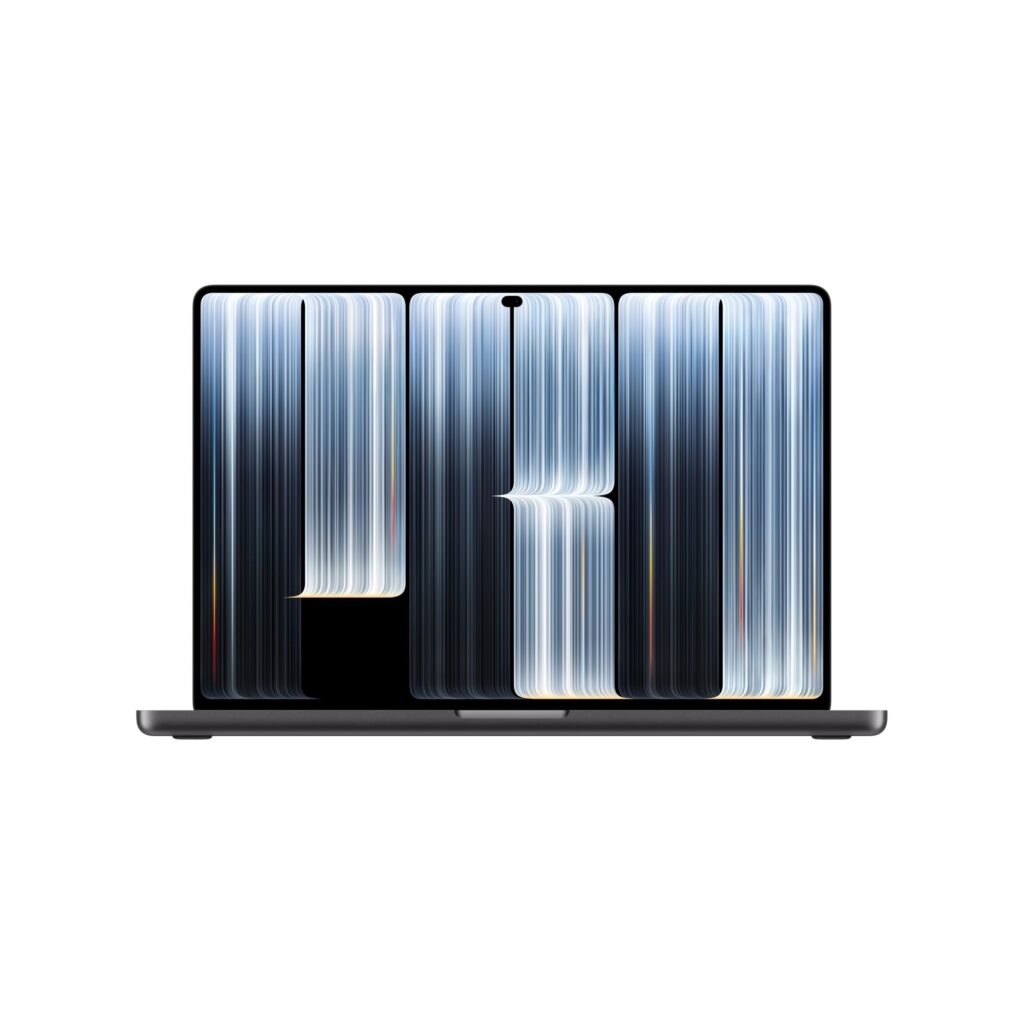
- High-efficiency M5 Pro architecture with 18 CPU cores, 20 GPU cores, and 307GB/s memory bandwidth
- Triple Thunderbolt 5 connectivity supporting peripheral bandwidth up to 120Gb/s
- Reference-grade 16.2-inch Mini-LED display with 1600 nits peak HDR brightness
- Silent acoustic operation under standard editing, audio, and production workloads
- Included 140W power adapter may provide insufficient power delivery during sustained peak CPU and GPU load
- Integrated SDXC card slot does not support SD Express transfer speeds
- Soldered unified memory and solid-state storage prevent post-purchase hardware upgrades
Overview
Long-standing benchmarks for professional portable workstations find new footing in an enclosure where tactile refinement and visual fidelity take center stage. The familiar CNC-machined unibody chassis delivers exceptional structural rigidity with zero keyboard deck flex, paired with a display hinge calibrated for smooth single-finger opening and stable positioning. Anchoring the physical experience is the 16.2-inch Liquid Retina XDR Mini-LED panel, operating at 3456 x 2234 resolution with 120Hz ProMotion adaptive refresh. Delivering 1000 nits of sustained full-screen luminance alongside 1600 nits peak HDR highlights, the display offers dependable color accuracy for high-end studio workflows, complemented by a deep-travel scissor keyboard and an expansive glass Force Touch trackpad.
Internal processing centers on the M5 Pro system-on-chip, uniting an 18-core CPU and 20-core GPU across a shared 307GB/s memory bus. The platform upgrades internal storage throughput to a dedicated PCIe 5.0 interface and adds Wi-Fi 7 wireless connectivity alongside three Thunderbolt 5 controllers supporting bidirectional transfers up to 120Gb/s. In daily production workloads and editing tasks, the dual-fan thermal assembly remains virtually silent, circulating air efficiently while preventing heat buildup from warming the aluminum palm rests.
Sustained mobile productivity benefits from the 100Wh internal battery, maintaining full working-day operation without an AC connection. However, continuous peak utilization across all processing and graphics cores can push the boundaries of the included 140W power adapter, potentially requiring supplemental draw during heavy multi-engine renders. Additionally, the built-in SDXC reader omits high-speed SD Express support, and all unified memory and storage modules remain permanently soldered to the mainboard. For professionals seeking uncompromised mobile color fidelity, class-leading port bandwidth, and seamless firmware integration, the platform establishes an exceptionally high standard of mechanical reliability.
Technical Specifications
| Brand | Apple |
| Model | MacBook Pro 16.3-inch (2026) M5 Pro |
| Processor | Apple M5 Pro (18-core CPU: 6 super cores, 12 performance cores) |
| Graphics | Apple M5 Pro 20-core GPU with hardware ray tracing |
| Neural Engine | 16-core Neural Engine |
| Memory Bandwidth | 307GB/s |
| Unified Memory | 24GB (configurable to 48GB or 64GB) |
| Storage Interface | 1TB PCIe 5.0 SSD (configurable to 2TB or 4TB) |
| Display | 16.2-inch Liquid Retina XDR Mini-LED (3456 x 2234, 120Hz ProMotion, 1000 nits sustained SDR/XDR, 1600 nits peak HDR) |
| Battery Capacity | 100Wh lithium-polymer |
| Battery Life Rating | Up to 24 hours video playback / up to 17 hours wireless web |
| Power Delivery | 140W USB-C Power Adapter (MagSafe 3) |
| I/O Ports | 3x Thunderbolt 5 (up to 120Gb/s), 1x HDMI, 1x SDXC slot, 1x 3.5mm headphone jack, 1x MagSafe 3 |
| Wireless Connectivity | Wi-Fi 7 |
| Camera | 1080p FaceTime HD |
| Available Finishes | Space Black, Silver |
Primary Sources & Audited Citations
Recommended Alternatives in Laptops

At a Glance
How reliable is the Apple MacBook Pro 16.3-inch (2026) M5 Pro according to Mizex audits?
An exceptional workstation laptop for creative professionals who prioritize display accuracy, silent everyday acoustics, and battery life, provided memory and storage configurations are finalized at purchase.
What are the known quirks or drawbacks of the Apple MacBook Pro 16.3-inch (2026) M5 Pro?
Our reliability audit identified the following documented caveats:
- Included 140W power adapter may provide insufficient power delivery during sustained peak CPU and GPU load
- Integrated SDXC card slot does not support SD Express transfer speeds
- Soldered unified memory and solid-state storage prevent post-purchase hardware upgrades
What are the key engineering highlights of the Apple MacBook Pro 16.3-inch (2026) M5 Pro?
The top strengths recorded in our evaluation include:
- High-efficiency M5 Pro architecture with 18 CPU cores, 20 GPU cores, and 307GB/s memory bandwidth
- Triple Thunderbolt 5 connectivity supporting peripheral bandwidth up to 120Gb/s
- Reference-grade 16.2-inch Mini-LED display with 1600 nits peak HDR brightness
- Silent acoustic operation under standard editing, audio, and production workloads