
- Up to 3-year battery life using standard off-the-shelf cells
- Dedicated sub-GHz Z-Wave protocol provides up to 250 ft (76 m) of wireless range
- Adjustable pet-immunity thresholds accommodate animals up to 49 lbs (22 kg)
- Versatile chassis design supports both corner and flat-wall mounting
- Requires a Ring Alarm or Alarm Pro Base Station with no standalone operation
- Hardware locked to regional radio frequencies (868 MHz vs 908/916 MHz)
- Cold ambient temperatures substantially degrade battery longevity
Overview
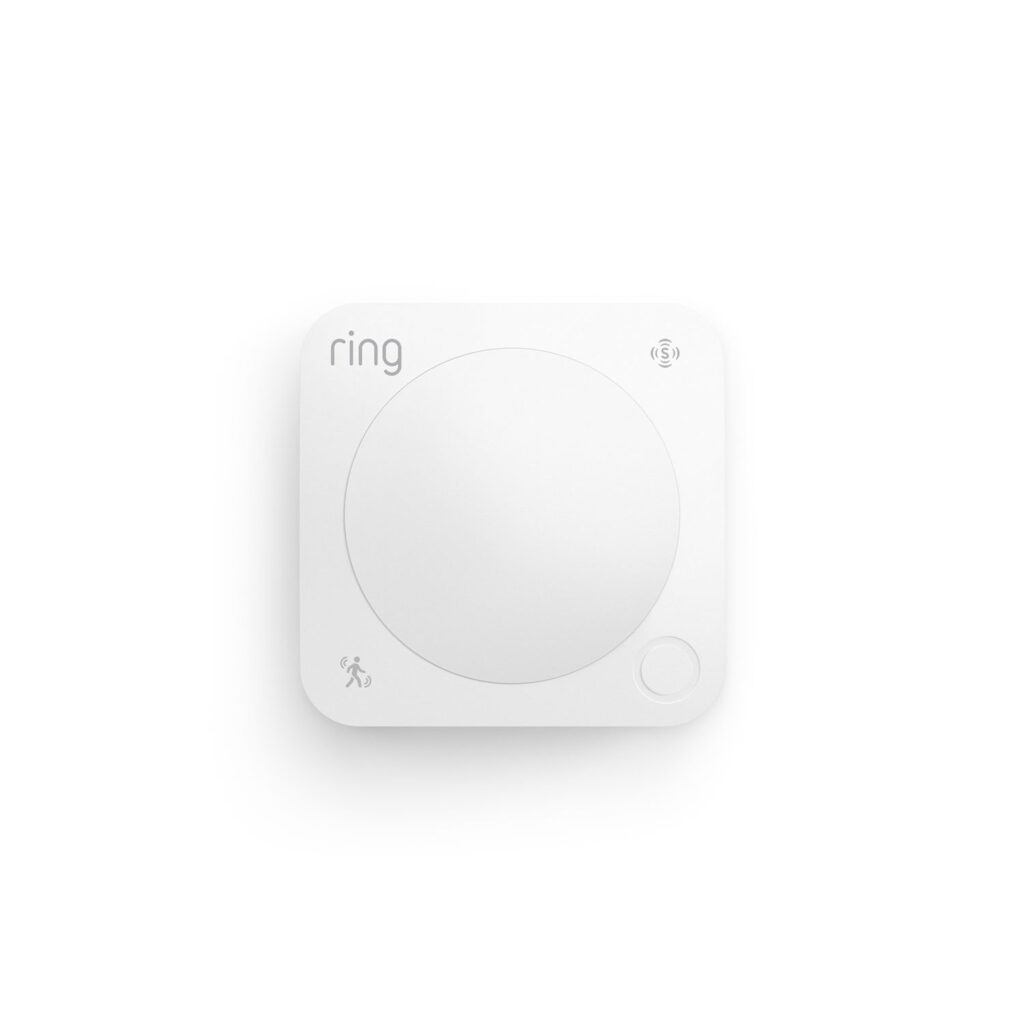
Securing large living spaces without triggering constant false alarms demands precise optical calibration and disciplined power conservation. Ring approaches interior monitoring through a focused passive infrared sensor paired with a 90-degree horizontal field of view, tracking moving heat signatures rather than pixel shifts. Operating over dedicated sub-gigahertz Z-Wave channels—utilizing 908 MHz and 916 MHz bands in North America and 868 MHz in Europe—the detector sidesteps congested 2.4 GHz household Wi-Fi traffic while delivering up to 250 ft (76 m) of direct line-of-sight transmission back to a central base station.
Physically, the housing accommodates straightforward flat-wall placement or angled corner mounting, positioned at 7 ft (2.1 m) for first-generation units or 7 ft 6 in (2.3 m) for second-generation hardware to maintain optimal optical coverage. Power delivery relies on easily sourced consumer cells—either a single 3V CR123A lithium cell in early units or dual AA batteries in second-generation designs—yielding up to three years of continuous standby. While normal room ambient temperatures preserve this extensive operational window, prolonged exposure to unheated or freezing spaces significantly accelerates chemical cell discharge, shortening effective maintenance intervals.
Day-to-day deployment hinges on careful calibration to avoid nuisance triggers from household animals. Multi-tier sensitivity thresholds filter out pets weighing up to 49 lbs (22 kg) on the lowest setting, though energetic pets climbing onto elevated furniture can still cross the optical threshold. Setup also carries practical pitfalls, such as failing to remove the protective shipping film, which renders the infrared lens blind until stripped. Crucially, the sensor is bound strictly to Ring Alarm or Alarm Pro base stations and regional radio frequencies, preventing standalone operation or cross-border hardware migration despite its durable and reliable indoor sensing profile.
Technical Specifications
| Brand | Ring |
| Model | Motion Detector |
| Detection Technology | Passive Infrared (PIR) |
| Wireless Protocol | Z-Wave |
| Operating Frequencies | 868 MHz (UK/EEA), 908 MHz and 916 MHz (US/CA) |
| Wireless Range | Up to 250 ft (76 m) line-of-sight to Base Station |
| Field Of View | 90° horizontal |
| Mounting Height | 7 ft (2.1 m) for 1st Gen; 7 ft 6 in (2.3 m) for 2nd Gen |
| Mounting Options | Corner mount or flat wall mount |
| Battery Configuration | 1x 3V CR123A lithium (1st Gen) or 2x AA alkaline (2nd Gen) |
| Rated Battery Life | Up to 3 years |
| Pet Immunity Weight Limit | Up to 49 lbs (22 kg) on low sensitivity |
| Sensitivity Presets | Low (pets up to 49 lbs / 22 kg), Medium (pets up to 28.7 lbs / 13 kg), High (immediate trigger) |
| System Compatibility | Requires Ring Alarm Base Station or Ring Alarm Pro Base Station |
Primary Sources & Audited Citations
Recommended Alternatives in Smart Home & IoT

At a Glance
How reliable is the Ring Motion Detector according to Mizex audits?
An essential, low-maintenance motion detector for existing Ring Alarm setups, provided you verify regional wireless compatibility and operate it within temperature-controlled indoor spaces.
What are the known quirks or drawbacks of the Ring Motion Detector?
Our reliability audit identified the following documented caveats:
- Requires a Ring Alarm or Alarm Pro Base Station with no standalone operation
- Hardware locked to regional radio frequencies (868 MHz vs 908/916 MHz)
- Cold ambient temperatures substantially degrade battery longevity
What are the key engineering highlights of the Ring Motion Detector?
The top strengths recorded in our evaluation include:
- Up to 3-year battery life using standard off-the-shelf cells
- Dedicated sub-GHz Z-Wave protocol provides up to 250 ft (76 m) of wireless range
- Adjustable pet-immunity thresholds accommodate animals up to 49 lbs (22 kg)
- Versatile chassis design supports both corner and flat-wall mounting