
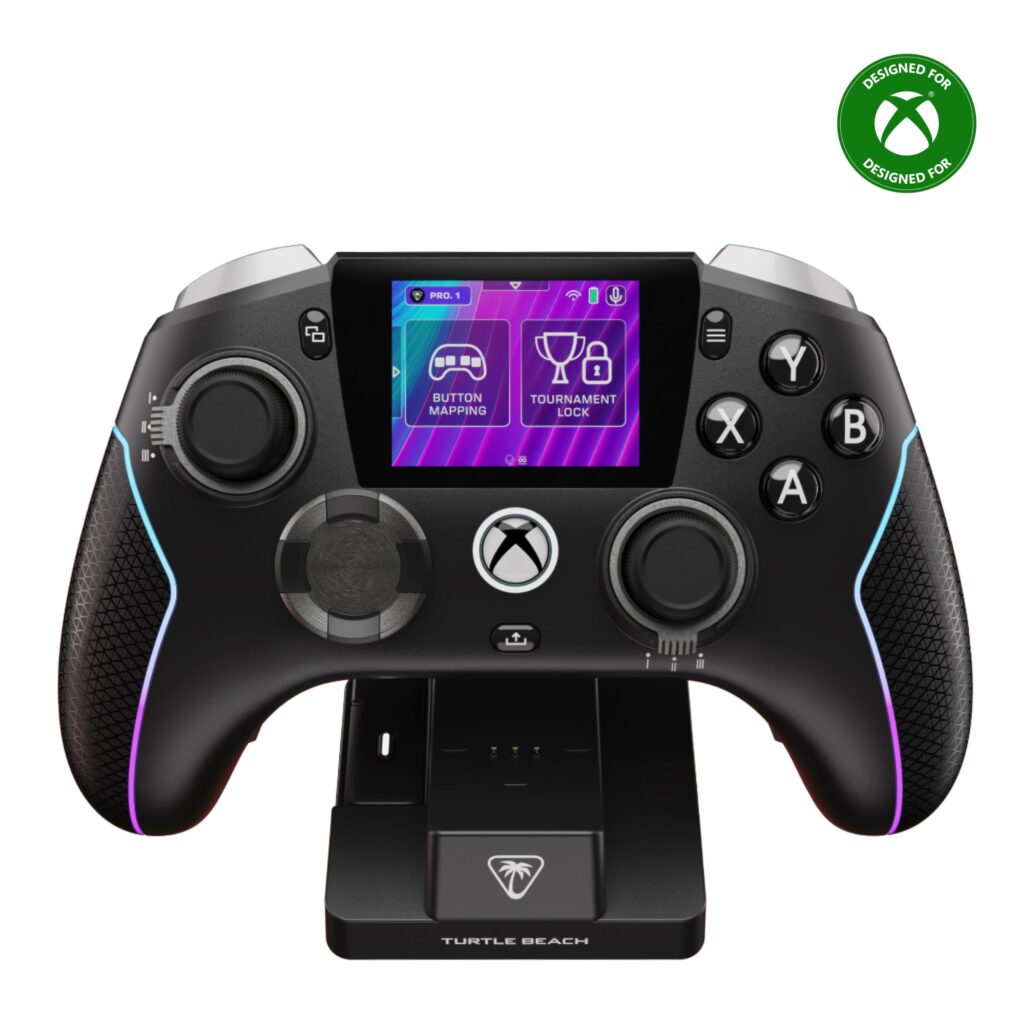
- Contactless AntiDrift TMR thumbsticks eliminate mechanical potentiometer wear
- High-speed wired polling up to 8,000 Hz and 1,000 Hz wireless reporting
- Integrated full-color touchscreen enables comprehensive hardware tuning without software
- Tactile microswitch inputs across action buttons and rear mappable paddles
- Heavier chassis profile at 11.36 oz (322 g) compared to standard gamepads
- Modest out-of-the-box battery life of 12 hours prior to activating Eco mode
- No native compatibility with PlayStation console hardware
Overview
Integrating an active display directly into a competitive gamepad fundamentally changes how players interact with their hardware settings mid-session. Rather than requiring background desktop software or multi-step key combinations, the built-in color touchscreen provides immediate access to dead-zone calibration, audio levels, and button mapping directly on the device. Below the display, the analog sticks employ contactless Tunnel Magnetoresistance (TMR) sensors, which read position via magnetic resistance changes rather than rubbing carbon contacts. This contactless foundation is paired with physical GateShift sliders that mechanically adjust stick travel boundaries between circular and octagonal profiles, while tactile microswitches across the action buttons and directional pad deliver crisp, immediate actuation.
In everyday competitive play, the controller bridges the gap between console convenience and high-performance PC inputs. Wired operation scales up to an 8,000 Hz polling rate for near-instant signal delivery, while 2.4 GHz wireless connectivity holds steady at 1,000 Hz for desktop and Xbox environments. The rear grip houses four assignable microswitch paddles positioned flush with the natural finger curl, complemented by three-stage physical trigger stops that switch from full analog throw to shallow hair-trigger clicks for rapid fire. Structurally, the assembly feels dense and solid in the palms, though its 11.36 oz (322 g) curb weight makes it notably heavier during endurance sessions compared to barebones first-party gamepads.
Power management revolves around a low-profile magnetic charging dock that keeps the controller topped off between play sessions. The internal battery provides roughly 12 hours of continuous use in its standard operating mode with the touchscreen and wireless radios active, though switching into the firmware’s dedicated Eco mode can extend operational longevity up to 34 hours by throttling back non-essential power draw. With microswitch-based tactile actuation dampening acoustic rattle and magnetic sensors removing the primary failure point of traditional analog sticks, the hardware delivers a robust, enthusiast-grade platform for Xbox and PC ecosystems, despite the complete absence of PlayStation console compatibility.
Technical Specifications
| Brand | Turtle Beach |
| Model | Stealth Ultra II |
| Platform Compatibility | Xbox Series X|S, Xbox One, Windows 10 & 11, Android 8.0+, Bluetooth-enabled Smart TVs |
| Connectivity | 2.4 GHz wireless, Bluetooth 4.2+, USB wired |
| Wired Polling Rate | Up to 8,000 Hz (8 kHz) |
| Wireless Polling Rate | 1,000 Hz (1 kHz) |
| Thumbstick Architecture | AntiDrift TMR (Tunnel Magnetoresistance) |
| Stick Profile Customization | GateShift physical sliders (3 virtual gate profiles) |
| Switch Architecture | Tactile microswitches |
| Mappable Controls | 4 tactile microswitch rear buttons |
| Trigger Stops | 3-way adjustable (hair trigger, medium travel, full travel) |
| Display | Connected Command full-color touchscreen |
| Battery Life | Up to 12 hours (Standard); up to 34 hours (Eco mode) |
| Charging Interface | Low-profile rapid charge dock |
| Weight | 11.36 oz (322 g) |
| Included Accessories | Rapid charge dock, protective carry case |
Primary Sources & Audited Citations
At a Glance
How reliable is the Turtle Beach Stealth Ultra II Review: TMR Precision Meets Touchscreen Control according to Mizex audits?
An outstanding choice for PC and Xbox players prioritizing onboard tuning and contactless stick longevity, provided the 322 g heft and lack of PlayStation support fit your setup.
What are the known quirks or drawbacks of the Turtle Beach Stealth Ultra II Review: TMR Precision Meets Touchscreen Control?
Our reliability audit identified the following documented caveats:
- Heavier chassis profile at 11.36 oz (322 g) compared to standard gamepads
- Modest out-of-the-box battery life of 12 hours prior to activating Eco mode
- No native compatibility with PlayStation console hardware
What are the key engineering highlights of the Turtle Beach Stealth Ultra II Review: TMR Precision Meets Touchscreen Control?
The top strengths recorded in our evaluation include:
- Contactless AntiDrift TMR thumbsticks eliminate mechanical potentiometer wear
- High-speed wired polling up to 8,000 Hz and 1,000 Hz wireless reporting
- Integrated full-color touchscreen enables comprehensive hardware tuning without software
- Tactile microswitch inputs across action buttons and rear mappable paddles